A Magazine from Akron Children's

Gwen Stine became aware at an early age that her S-shaped spine was going to make life difficult.
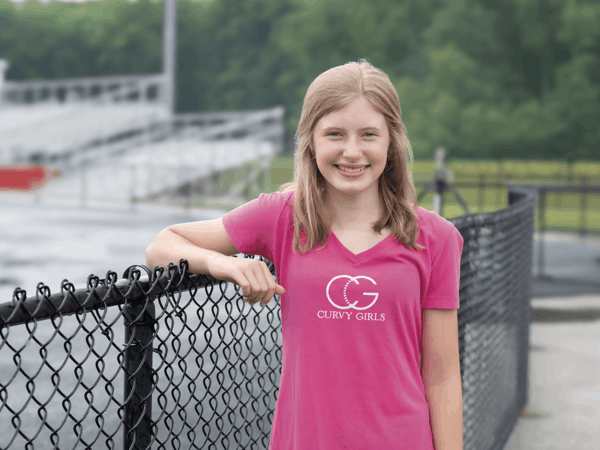

Gwen attends Curvy Girls, a scoliosis support group where monthly activities help build confidence and self-esteem.
Diagnosed with scoliosis at age 5, she had to wear a back brace for up to 18 hours a day. Kids at school would question her about it and ask if her back was broken. But that wasn’t the worst thing. “Gwen experienced back pain on a daily basis,” said her mother, Joelle.
Despite wearing that brace for seven years, Gwen's condition became progressively worse as she approached puberty. Her curve increased dramatically to surgical range.
Employing rods and screws, spinal fusion surgery has long been the gold standard for treating severe scoliosis. “But fusing the lumbar (lower) spine can have a marked impact on the patient’s range of motion,” said Dr. Todd Ritzman, Akron Children’s surgeon in chief and Gwen’s pediatric orthopedic surgeon. “And, long term, we fear the few remaining discs patients have in their low back might degenerate, get arthritic or have pain, requiring treatment in the future.”
Dr. Ritzman thought Gwen was a good candidate for a new hybrid option in scoliosis treatment called vertebral body tethering (VBT). It’s an option for a subset of pediatric patients with scoliosis — those who still have significant growing to do — and it can be offered to some patients in conjunction with spinal fusion.
VBT is a “growth modulation” treatment that uses anchors attached to vertebrae on the side of the spine that curves outward and a flexible tether to guide the spine into upright alignment as the child grows. It takes advantage of the spine’s natural growth to correct the curves. It is minimally invasive compared to spinal fusion.
In some cases, the pediatric orthopedic surgeons at Akron Children’s believe the best of both worlds may be to combine these two surgeries, fusion of the thoracic (upper) spine and VBT of the lumbar spine, to preserve the child’s spinal range of motion. This could make a difference for future participation in dance, gymnastics, diving, cheerleading and other activities that require considerable flexibility.
Joelle and her husband, Greg, felt comfortable with Dr. Ritzman’s recommendation.

Gwen embraces school life again, including cheerleading, after vertebral body tethering.
Before surgery, Joelle and Gwen were thrilled to discover the scoliosis support group, Curvy Girls, had a local chapter. They began attending monthly meetings. While moms share news of the latest scoliosis research in one room, the girls hang out in another doing activities that promote friendship and build self-esteem. Joelle and Gwen even attended a Curvy Girls international convention in New York.
“One of the reasons I love Dr. Ritzman is I would ask him about a study I learned of through Curvy Girls, and he would always be aware of it,” said Joelle.
“It was cool to see other girls, older girls, who wore braces and had scoliosis,” said Gwen, currently the leader of the Cleveland chapter. “I would think, ‘They’re cool, so I’m going to be cool.’”
As a busy seventh grader hoping to get back to school, the hybrid approach proved to be a great option. In October 2025, Gwen underwent two procedures — fusion of the thoracic (upper) spine and VBT of the lumbar spine — on the same day. Within six weeks, she was back to school, practicing for her school musical and had even returned to cheerleading — mounts, jumps and cartwheels.
Dr. Ritzman and his Akron Children’s colleagues, Drs. Lorena Floccari and Walter Samora, are all full-time pediatric spine surgeons and active members of the Scoliosis Research Society and the Pediatric Spine Study Group. Dr. Ritzman is also a member of the Harms Study Group.
“We are very excited about the hybrid approach,” Dr. Ritzman said. “It combines the best advantages of each approach. Fusion is a very reliable, reproducible procedure with really good outcomes in the thoracic spine — while VBT preserves motion and the ability to perform preoperative activities in the lumbar spine.”
The key, says Dr. Ritzman, is selecting patients who are the best candidates — those with lots of growth and those who know a second surgery could still be necessary after VBT. Tethers can break, fail to correct the curve or overcorrect the curve requiring a second procedure in 12% to 15% of patients.
Doing the procedures at the same time — about eight hours in Akron Children’s dedicated spine operating room — saved Gwen and her family the anxiety and recovery associated with two separate surgeries.
“I spent a few nights in the hospital but was home in my own bed by the fourth day,” said Gwen. “At one of the follow-up appointments, we asked Dr. Ritzman about restrictions on activities like sports and roller coasters. He said, ‘Go live your life.’”
“We are thrilled with the outcome,” said Joelle.
Gwen is doing exactly what Dr. Ritzman said to do — living her life fully at school, with friends and family, and being more active than ever. She plans to stay involved with Curvy Girls, helping and supporting other girls on their journey with scoliosis.
This past Easter, Gwen opted to wear an open-back dress to show off her spinal fusion scar.
“It’s a badge of courage,” she said.
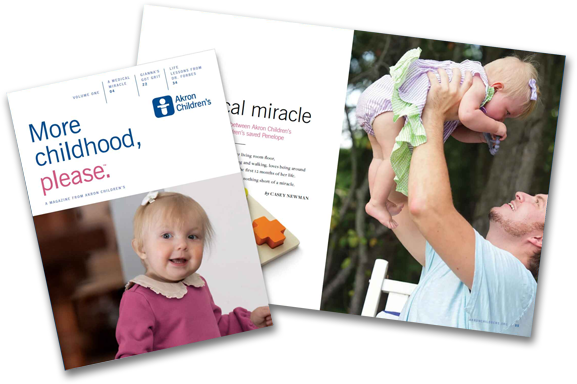
From inspiring stories, to medical miracles, the More childhood, please.® magazine will make you appreciate those precious 6,574 days of childhood.
SubscribeAkron Children's invites you to connect with us.


