
A Magazine from Akron Children's

Imagine feeling bloated every time you eat, like you ate too much on Thanksgiving, and you often vomit afterward. That’s what life has been like for 17-year-old Gaby Camacho of Amherst, Ohio. With a new diagnosis of “gastroparesis,” a chronic condition where stomach muscles don’t work properly to push food to the small intestine, it’s a daily struggle to feel decent and maintain
her weight. But thanks to the Akron Children’s Motility Program, Gaby has hope for a better future.
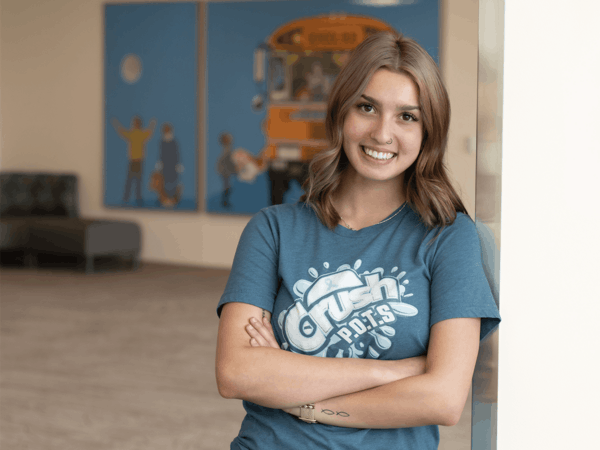

Gaby wants other people with chronic conditions to know they’re not alone.
She has faced health problems her whole life. She has “Hypermobile Ehlers-Danlos syndrome (hEDS),” a genetic disorder affecting the body’s connective tissue that supports structures like joints, ligaments, tendons, skin, blood vessels and internal organs. Her hEDS symptoms include many gastrointestinal problems, and her skin can tear easily.
In addition, she has “Postural Orthostatic Tachycardia Syndrome (POTS)” that causes a fast heart rate and dizziness when standing up. Gaby also suffers from migraine headaches.
She started seeing an Akron Children’s gastroenterology doctor in 2024 because she constantly felt nauseous and bloated. “I vomited so often that I had to switch from public school to homeschooling,” Gaby shared. “Even drinking water made me feel full, and I didn’t want to throw up in my school bathroom all the time.”
Gaby participated in school plays and productions, as well as competitive dancing, beginning at age 8. “She started having unexplained health complications in middle school,” her mom, Gina, said. “Her last dance competition was at age 15, and then she had to give up dancing due to severe complications with gastroparesis, hEDS and POTS. It was devastating.”
A gastric emptying scan in October 2025, which measured how quickly food left Gaby’s stomach, came back normal. As her symptoms worsened, she was referred to the Akron Children’s Motility Program in
February 2026. “Motility” refers to the way food and fluids move through our gastrointestinal tract, starting at the mouth and ending at the rectum.
“When I met Gaby and Gina, I asked them to give me time to figure this out,” said Dr. Shivani Gupta, director of the Akron Children’s Pediatric Neurogastroenterology and Motility Program. “I began studying Gaby and her rare combination of conditions because I want to help her feel better.”
Gaby had a six-hour diagnostic test in April. It measured and recorded muscle contractions in her lower stomach and upper small intestine when she ate or had stomach-stimulating medicine. The test can help to identify the cause of hard-to-diagnose gastrointestinal symptoms.
The test showed Gaby has gastroparesis. It’s not curable, but there are ways to manage the condition.
Dr. Gupta started by trying different medications for Gaby, and they didn’t help much. Gaby experimented with eating several small snacks and high-calorie foods throughout the day instead of meals, as recommended by the dietitians who are part of her Motility Program team. “I have a mini fridge in my bedroom that’s stocked with Ensure shakes; I drink those and a lot of water each day,” she shared. “Calories are important to maintain my weight, even if they’re not the healthiest foods, so I eat Twinkies and Goldfish crackers. Baby food, canned fruit and applesauce are also parts of my diet.”
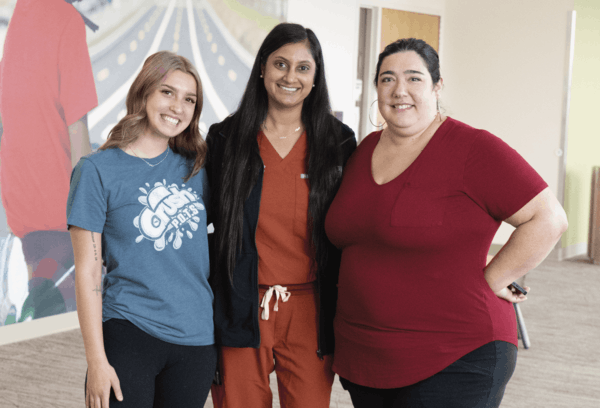
Dr. Shivani Gupta (center) is hopeful a gastric stimulator will improve Gaby’s quality of life.
Gaby had a two-week trial of an external gastric stimulator in September, also called a gastric pacemaker. This is a small device that sends slight electrical pulses to the stomach muscles, causing the stomach to churn with the goal that food will pass more easily through the stomach to the small intestine. This technology has been shown to reduce the frequency of vomiting and nausea — ultimately improving patients’ quality of life.
If Gaby experiences symptom improvement, she’ll have surgery to get a permanent stimulator implanted. “We’ll place it under the skin of her abdomen, with two wires connecting the device to her stomach muscles,” Dr. Gupta explained. “We’ll start on the lowest setting of the device. We can change the frequency and power of the pulses, noninvasively, by holding a programming device over the skin where the stimulator is located.”
Gaby and Gina joined the “Zebras Assemble” group on TikTok; zebras are the mascot for people with rare diseases like hEDS. They now have their own TikTok handle — Zebra Coded — and welcome anyone struggling with chronic conditions and mental health.
“I believe this is happening for a reason,” Gina said. “We’re sharing our story in the hopes that people with hEDS, gastroparesis and other conditions keep fighting like Gaby has. We want them to know they’re not alone.”
Their efforts are working, as they have more than 6,000 TikTok followers. They post videos, answer questions, share information and even referred a person from New York to Dr. Gupta.
While Gaby and her family eagerly wait for the next steps with the stimulator, they’re grateful for Dr. Gupta and the Motility Program team. “They are awesome,” Gaby said. “Dr. Gupta said she was going to help, and
she gave us hope for the first time in a long time. Before, I felt dismissed and alone. Now, I feel seen and heard.”
Look for a follow-up story about Gaby in the next issue of the “More childhood, please.” magazine.
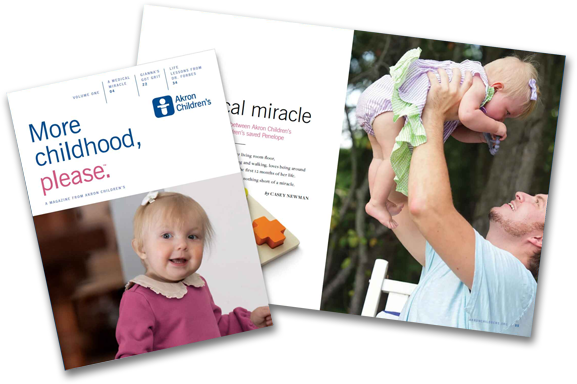
From inspiring stories, to medical miracles, the More childhood, please.® magazine will make you appreciate those precious 6,574 days of childhood.
SubscribeAkron Children's invites you to connect with us.


