A Magazine from Akron Children's

As the need for pediatric behavioral health services continues to grow, Akron Children’s is opening a new, expanded inpatient behavioral health unit to improve access for children and families.
As the need for pediatric behavioral health services continues to grow, Akron Children’s is opening a new, expanded inpatient behavioral health unit to improve access for children and families.
Eva Szigethy, MD, PhD, the Lois C. Orr Endowed Chair in Pediatric Psychiatry, said the new unit will not only expand the organization’s capacity for inpatient care — it will reshape how that care is delivered.
“This new unit is much more than a larger space with more beds. It’s really reengineering how we provide behavioral health care and how we train staff to optimize the safety of our patients in a therapeutic environment,” said Dr. Szigethy. “We wanted to make sure that we provided a tiered hospitalization experience with different subunits and programming for kids with a diversity of needs.”
Opening in spring 2026, the behavioral health unit will move from its current location on the eighth floor of the main hospital building on the Akron campus to a newly renovated space on the fifth floor of the Kay Jewelers Pavilion. With a total of 40 inpatient beds for patients ages 5 to 18, the space will be divided into three units based on the patient’s diagnosis and the level of support needed: regular-acute care, high-acute care and crisis stabilization.
The new crisis stabilization unit provides brief, intensive crisis management for kids who require a short hospitalization, averaging three to four days. Dr. Szigethy shared that it will provide a new care pathway for patients who are often seen in the emergency room but don’t require a long-term stay for treatment.
“The objective of the stay is truly, as the name suggests, to give the child and the family the crisis management skills they need, as well as a few days to prepare at home,” she said. “We connect them to resources in the community, either with our programs or our community partners. The parents can safety-proof their house, get extra support for their child in school and benefit from more intensive parent training.”
Donna Koterba, MSN, RN, NE-BC, CRRN, director of the inpatient behavioral health unit, said that allowing parents and caregivers to stay overnight with their child is an important new undertaking for the unit.
“Our new crisis stabilization unit will keep families involved and connected during a difficult time,” she said. “Families are considered partners in care, not visitors, and this new unit will help to strengthen the entire family’s coping skills.”

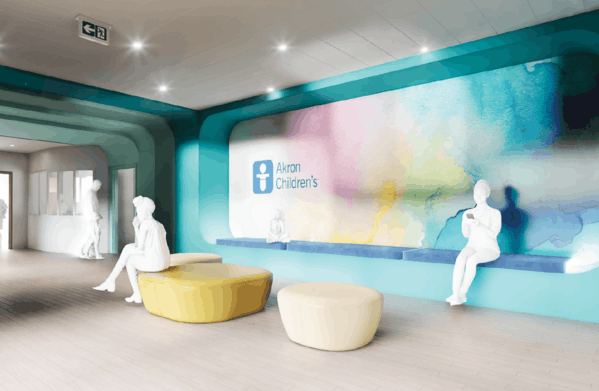
The renderings reveal a first look at the new inpatient behavioral health unit. This expanded, reimagined space is designed to increase access to care and transform the way patients are supported.
The new space’s thoughtful design uses therapeutic architecture, incorporating color schemes and natural light that have been shown to reduce stress and promote healing.
It features a spacious gym for structured group activities and exercise, a multimedia room, a sensory stimulation room and a large outdoor area. “I’m so excited that our patients will be able to get outside,” Donna expressed. “It’s going to create a calming, natural environment that encourages physical activity and movement, which is essential to their mental health and well-being.”
Dr. Szigethy described how the new space will support improvements to behavioral health programming. “We’re implementing a program that encourages behavior change through positive reinforcement by staff using a token economy system,” she said. “Families are trained in these positive reinforcement techniques so they can maintain them once the child goes home.”
Donna said as more children and teens in our region struggle with anxiety, depression and other mental health disorders, this new unit will help to provide essential behavioral health care services closer to home.
“There are so many kids who are in crisis and need help,” she said. “Having this expanded space is going to open the door for more kids, especially through the crisis stabilization unit. Not every child who comes to the hospital in crisis needs to stay here for a long time. Sometimes they’re just going through a hard time or trauma, and we’ll help them work through it.
“This new unit represents hope for children and families, who may not have otherwise had it,” she added. “It will provide an atmosphere that understands mental health and the care that is essential to healing.”

Participants at the summer behavioral health camp engage in art and journaling activities, using creative projects as tools for reflection and building healthy coping skills.

From inspiring stories, to medical miracles, the More childhood, please.® magazine will make you appreciate those precious 6,574 days of childhood.
SubscribeAkron Children's invites you to connect with us.