A Magazine from Akron Children's
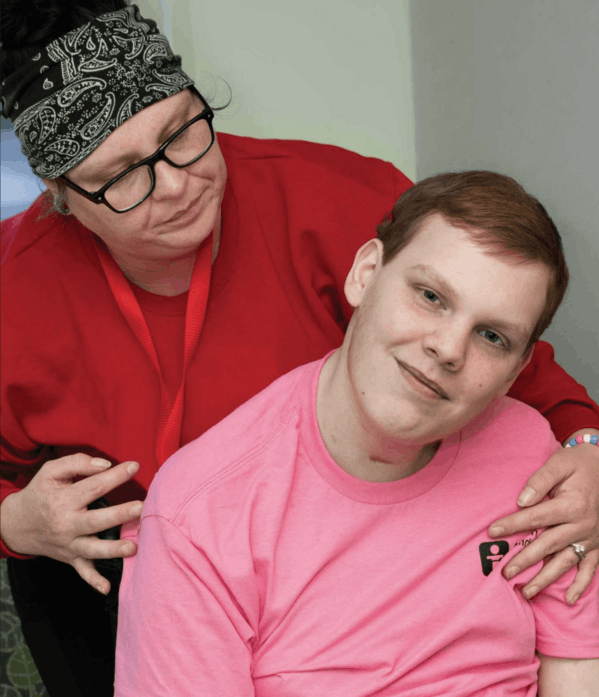
We all have a relationship with hope. It’s often there, leading the way in both big and small ways. In some of life’s toughest situations, we cling to it with an ironclad grip, our white knuckles the North Star that guides us through the dark. Mason Jones and his family are no strangers to that white-knuckled grip on hope. Throughout the past 20 months, hope was not just a guiding light for them – but, at times, the only light that helped them through Mason’s close call with death and navigating his new life as an amputee.
In April 2023, 15-year-old Mason got sick with what seemed like a regular case of strep throat. But when his mom, Charde McMillan, noticed purple splotches all over his body, she knew something else was wrong.
After some blood work at their local hospital in Pearisburg, Virginia, the doctors confirmed her biggest fear: Mason was in organ failure.
“They life-flighted him to Roanoke,” Charde said, “and they weren’t even sure if they could keep him alive overnight.” The doctors immediately put Mason into a medically induced coma, on life support and dialysis. Just eight hours later, he was life-flighted again to the University of Virginia Medical Center, where he would remain in a coma for more than three months. Their family packed a bag and hit the road to be with him.
“That first night, one of the doctors told me that it was OK to have hope,” Charde reflected. At first, she worried what that meant. Was he trying to comfort her, even though he feared the worst? Ultimately, however, she realized how badly she needed it. “We held onto that hope because that’s really all we had.”
Finally, after weeks of waiting while Mason was on life support, his family received a diagnosis. Mason had group A streptococcal toxic shock syndrome, which causes sepsis and organ failure, and can often be fatal.
Mason was fighting for his life.
“There were horrible feelings all day, every day,” Charde recalled. “Just this hole in your gut because you never knew, minute by minute, what was going to happen to Mason.”
As the oldest of four siblings, Mason had always been an active, ambitious kid. He enjoyed being outside hiking or biking, had a strong interest in photography and loved playing video games. Seeing her strong, independent and energetic son fighting for his life in a coma had begun to take its toll on Charde.“I couldn’t sit in his room for very long, with all the horrible machines. I would have anxiety attacks. So, I spent most of my time in the waiting room.”
But Mason couldn’t survive on those machines forever. His doctors warned Charde that after so long, it would begin to cause brain damage. They gave her a choice: try weaning him off the machines now and see how his body responds, or risk waiting a little longer. They chose to wean him from life support. As he was weaned, Charde and her family held firmly to whatever hope they could find. “I always have hope for him, and I always will. But it’s definitely hard to hold onto when you’re so helpless – when it comes to your child’s life, and there is literally nothing you can do.”
Even while Mason was on life support, though, Charde suspects he sensed his family rallying behind him – a light guiding him back to them. “I’m happy we held out hope because I feel like maybe that made Mason fight a little bit harder, knowing that we were there with him.”
But they weren’t through the darkness yet. After more than three months on life support, Mason had developed necrotizing fasciitis, a flesh-eating bacterial infection that destroys soft tissue and can often be fatal. The immediate action to stop the spread was to amputate Mason’s hands and feet.
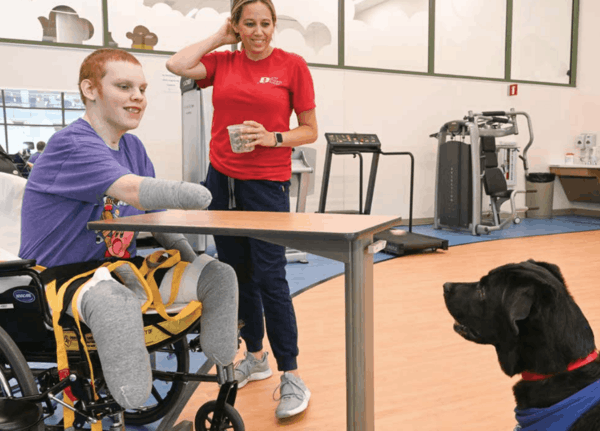

The rehab team found fun ways to engage Mason in beneficial exercises. Here, he was throwing treats for a member of the Doggie Brigade™, which often joins patients in the rehab gym to help inspire and motivate them during difficult periods of healing.
Charde and her family worried how Mason was going to react to waking up with no hands after his first surgery. But Charde had a feeling that her son would be resilient, even in the face of such drastic change. “Mason has always looked for the light in the darkest places, and somehow, he can make any situation better. He always has.”
And Mason proved her right.
“He came out really, really positive,” said Charde. “He’s determined to get to do what he wants to do. He wants independence, and nothing is going to stop him.”
Charde was overwhelmed and scared on the day he had his feet amputated, but Mason was laughing as he was wheeled out of his room to surgery. That attitude was a game-changer for her, and he became the light that guided her.
“If he’s OK with this, then I can be OK,” she said. “It strengthens our hope to see him so determined and positive. He says, ‘Mom, don’t be upset. I’m fine.’”
After having his hands and feet amputated, Mason was referred to Akron Children’s Adult and Pediatric Burn Institute, supported by The Paul and Carol David Foundation, for his complex and ongoing wound care. The family stayed at the Akron Ronald McDonald House for five months as they managed Mason’s wounds and worked through rehabilitation.
Within a week of being at Akron Children’s, Charde saw a huge improvement in Mason. Anjay Khandelwal, MD, director of the Burn Institute, along with his team, removed the tracheostomy and many IVs hooked to Mason. But more than anything, Charde says the team’s genuine, compassionate care was what made a big difference for them.
Dr. Khandelwal described the ability to find hope and stay motivated throughout the healing journey as an essential part of any patient’s recovery, and it is always a team effort.
“This is more than just the physical amputations,” said Dr. Khandelwal. “A lot of this is an emotional and mental journey. It’s important for patients to derive strength and resilience from understanding that journey, then rely on hope while using the burn team as support.”
When a patient leaves the burn unit, they’re gifted a medal that honors their journey so far and what is yet to come. It prominently displays the words “COURAGE, STRENGTH, RESILIENCE and HOPE.”
“I think Mason has embodied a lot of those characteristics,” praised Dr. Khandelwal.
Even as Mason and his family began navigating prosthetics, wheelchairs and wound care, they were able to stay positive and resilient.
Charde said the Akron Children’s rehab team really encouraged Mason to use that positive attitude and determination to keep going.
They were especially impacted by seeing doctors and caregivers with different abilities. “It shows the kids that it’s possible for them to do anything, too,” Charde said. “They’re really positive role models for them.”
That positive influence, along with the unrelenting support from his family, helped fuel Mason’s positive visions for his future. He used that motivation to keep fighting.
Throughout their extended stay, Mason showed that he is still the same active, ambitious and independent teenager.
“It was still scary at times because we were entering a world we knew nothing about,” Charde expressed. “It was like we were living in someone else’s life. It didn’t feel real. But I always had hope Mason was going to just take it and run with it. He’s really proved that he’s not going to let it hold him down.”
Now, nearly two years after Mason initially got sick, the road to recovery is far from over. The family still splits their time among Charleston, Morgantown and Akron for Mason’s various procedures and rehabilitation. But Mason and his family are adjusting to their new normal and are eagerly making plans for his future.
This July, Mason will turn 18. Like every 18-year-old, independence is front of mind. “I hope to finally be able to get on with my life in the next year. I just want to be able to go out into nature whenever I feel like it, finish high school and get a job.”
And that reality is getting closer and closer. Although Mason already had leg prosthetics and had begun to walk again, he had to have an additional surgery that required having his prosthetics remade.
Mason received his new prosthetics earlier this year, and he and Charde continue to visit Akron Children’s for rehabilitation.
“My biggest milestone so far is most definitely walking,” Mason claimed. And more milestones will come.
But, even now, Charde says her journey with hope isn’t over. “There are days when you’re devastated, and everything makes you angry. But then you see him do something amazing like walking the first day he got his prosthetics, and you realize we’re going to get through this.”
The key to getting through it? Doing it together. Even in the darkest moments, Mason and his family were not alone. They had each other, their care teams, and a whole community of friends and family supporting their journey and reminding them where to find that spark of hope to guide them through it.
To any other kid or teen who may be experiencing something big and life-changing, Mason continues to share that light by encouraging them to keep fighting. “You can do anything if you try. I thought I would never even play video games again – but here I am!”
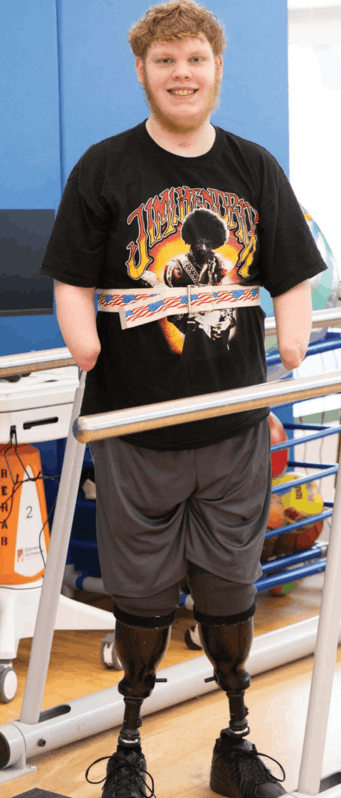
Walking was a major milestone for Mason.
In a rehab appointment last summer, he cruised through the hallways with minimal support from his therapist. The 17-year-old is over 6 feet tall and towers over most people around him when he is standing tall in his prosthetics.
From inspiring stories, to medical miracles, the More childhood, please.® magazine will make you appreciate those precious 6,574 days of childhood.
SubscribeAkron Children's invites you to connect with us.


