
Teaching children about consent helps them understand boundaries and to respect the boundaries of others.
When parents hear the word consent, they may immediately think about dating or sexual relationships. But consent is about much more than that. It starts with everyday interactions, from asking before hugging someone to respecting another person’s belongings and personal space.
Teaching children about consent early helps them understand their own boundaries and to respect the boundaries of others. And these lessons become even more important as children grow and begin navigating friendships, social media and romantic relationships.
“Discussing consent is definitely important as it relates to bodily autonomy and sexual relationships, however, consent is also an important part of everyday interactions,” said Dr. Kristin Lambert-Jenkins, an adolescent medicine physician at Akron Children’s.
So, how can parents make consent part of conversations with their children? Dr. Lambert-Jenkins offers these tips.
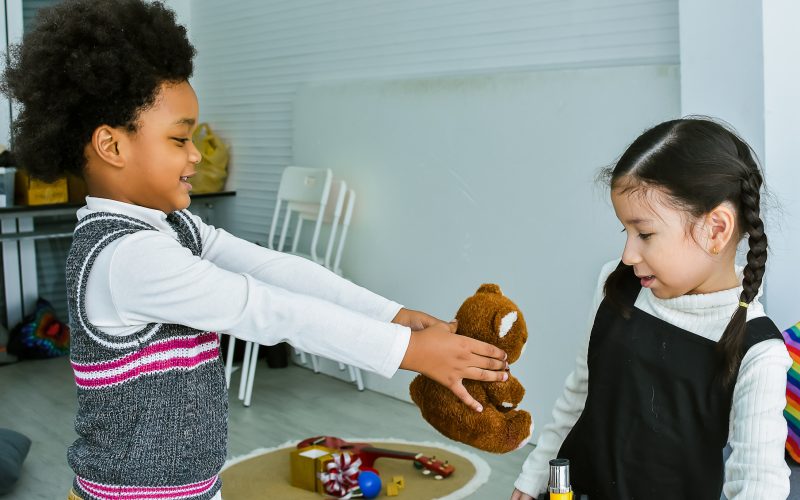
Young children can begin learning about boundaries through simple, daily situations like sharing toys.
Start with routine interactions
Parents don’t need to wait until their kids reach adolescence to introduce consent. Young children can begin learning about boundaries through simple, daily situations.
“For early childhood, I think of things like ‘asking nicely’ before using a toy or giving a friend a hug. Or using ‘nice hands’ when playing with other children or pets,” Dr. Lambert-Jenkins said.
Potty training also creates a natural opportunity to talk about body boundaries.
“After potty training is completed, or during that process, is a natural time to start talking about ‘private parts,’” she said. “Like when they need to be private, who is allowed to see them, and to tell a grown-up if those boundaries weren’t respected by someone.
“And that shouldn’t be a one-time conversation. Keep bringing it up,” she added.

Even when someone is a close relative, children should not feel obligated to give hugs or other physical affection. Teach them it’s OK to give a wave or a high-five instead if that makes them more comfortable.
Let children decide when they’re ready for a hug
Family gatherings offer another opportunity to teach children about consent. Even when someone is a close relative, children should not feel obligated to give hugs or other physical affection.
“If grandma really wants to hug your kid, but they are being shy when they walk in the room, don’t make them hug grandma,” said Dr. Lambert-Jenkins.
Instead, parents can offer a choice.
“Would you like to wave hello to grandma or give grandma a hug hello?” said Dr. Lambert-Jenkins. “Say it out loud, so you are setting that boundary and not putting refusing physical affection on your young child.”
This approach teaches children that they can make decisions about physical affection while still treating others kindly.

Just because it looks like “kids being kids” doesn’t mean it’s harmless. Roughhousing is only play when everyone involved is comfortable and consenting.
Teach kids that yes means yes
As children enter elementary school, parents can continue reinforcing privacy and bodily autonomy. They can also help children understand that physical contact may be appropriate in some situations but not others.
For example, tackling may be part of a sports game. That doesn’t mean it’s OK to tackle someone unexpectedly on the playground.
As children approach their tween years, conversations can become more specific.
Dr. Lambert-Jenkins notes that children may encounter sexual content online or through their peers before parents expect it. She cites research showing that about 15% of children report exposure to pornography before age 11.
Parents can open the conversation by asking whether their child has seen or heard anything online or at school that made them uncomfortable or confused.
As children reach adolescence, conversations can include more direct discussions about sex and relationships.
“Yes means yes, and almost everything else means no,” Dr. Lambert-Jenkins said. “Silence, saying ‘I don’t know,’ or mumbling should not be interpreted as consent.
“Also, if anyone in the conversation is intoxicated, no one should be asking them to make important decisions about their health or their body,” she added.
She emphasizes that the message applies to everyone, regardless of gender.
“The conversations we have with all young children, regardless of gender, should encompass both setting personal boundaries and respecting the boundaries of others,” she said.

Kids may encounter sexual content online or through their peers before parents expect it. Research shows about 15% of children report exposure to pornography before age 11. As children reach adolescence, conversations can include more direct discussions about sex and relationships.
Help children recognize other people’s boundaries
Consent isn’t always communicated with words. Children also need to learn how to recognize when someone feels uncomfortable.
Dr. Lambert-Jenkins encourages parents to point out nonverbal cues during everyday interactions.
For example, a dog that growls and pulls its ears back may be signaling that it doesn’t want to be petted. A child hiding behind a parent’s leg may not want a hug.
Parents can explain what they observe and why it matters.
Positive reinforcement also helps. When children respect someone else’s boundaries, let them know you noticed.
Dr. Lambert-Jenkins suggests telling a child: “Wow, I noticed you ask for a hug and your friend said no. You are such a good friend for listening to your friend’s words.”

Children notice how adults communicate, handle stress and work through conflict. Modeling healthy relationships and behaviors is important for your kids.
Model respectful relationships
Children learn about boundaries not only from what parents tell them, but also from what they observe.
Sometimes, family members, coaches or other trusted adults may say or do things that undermine lessons about consent.
Parents can address inappropriate behavior in the moment or talk privately with their child afterward. Either way, children should understand why the behavior was inappropriate.
Modeling healthy relationships also becomes increasingly important during the teen years. Children notice how adults communicate, handle stress and work through conflict.
“No person or relationship is perfect, but I think especially with teens, owning your faults and talking to them about what you are working on could be impactful,” Dr. Lambert-Jenkins said.
Keep the conversation open
For parents who haven’t talked about consent with their children, it’s never too late to start. The key is making these conversations feel natural rather than turning them into a one-time lecture.
“My strategy when I am meeting adolescents at work, sometimes for the first time, is to embrace the awkward. Acknowledge it out loud if you have to. Be authentic,” said Dr. Lambert-Jenkins.
A news story, something happening at school or a situation in the community can provide a natural starting point.
“I think it’s OK to be a vulnerable human being with your teen and talk about your hopes and fears for them, and for the world,” she said.
Most importantly, children need to know they can come to their parents without fear of a strong or negative reaction.
“Stay calm, listen and show your children you are on their team,” she said. “Building that trust during everyday situations can make it easier for children to ask for help when something more serious happens.”
For more advice, consult your child’s pediatrician.