E-bikes are heavier than regular bikes and can be difficult to handle. Don’t assume your child is ready for one. What’s not to love about a bike that gets you to your destination faster and with less effort?
E-bikes have surged in popularity but so have emergency room visits for injuries sustained by children and teens while riding them.
“By mid-July, we had surpassed the number of e-bike/scooter injuries than the entire year of 2025,” said Dr. Nathan Heinzerling, trauma medical director for Akron Children’s. “This includes brain injuries, fractures, road rash, lung contusions, and injuries to the liver, kidney, spleen and intestines.”
Akron Children’s has only recently begun counting e-bike injuries separately but is already recording about 35 to 40 each month, said Dr. Michael Bigham, chief quality officer.
“We have imperfect data, because often we describe ‘bicycle accidents’ generally, rather than specifically qualifying e-bicycle accidents,” Dr. Bigham said. “That said, it is certain that a greater percentage of those bicycle accidents than ever before are e-bike related.”
E-bikes have an electric motor and a rechargeable battery that power the bike.
What makes e-bike crashes different?
According to Heather Trnka, injury prevention manager for Akron Children’s, e-bike injuries are more severe because of three factors: speed, mass and road mix.
“Parents should not assume that their child who can ride a traditional bike has the skill and knowledge needed to safely ride an e-bike or scooter,” Heather said. “E-bikes can reach up to 28 miles per hour depending on class. They are heavier than regular bikes, which increases stopping distances and handling difficulty. We are also finding kids on e-bikes sharing space with cars, pedestrians, driveways, parked cars and school traffic.”
E-bikes come in three classifications:
Class 1: The bike motor only works when the rider is pedaling, and it can reach speeds up to 20 mph.
Class 2: These bikes have a motor controlled by a throttle, and you can use the bike with or without pedaling up to 20 mph. Keep in mind, the more you rely on the throttle without pedaling, the quicker you drain the battery.
Class 3: These bikes may or may not have a throttle and can reach top speeds up to 28 mph or more. In Ohio, riders must be 16 or older and wear a helmet.
The American Academy of Pediatrics (AAP) urges parents to be deliberate in their decision to buy an e-bike for their child, noting that readiness should be based on development and maturity, not just age. Can the child control speed? Judge distance? React to traffic? Navigate hazards like potholes, branches and pedestrians?
AAP does not recommend teens under 16 operate motorized e-bikes and scooters, which are more comparable to motorcycles than bicycles. But, if parents believe a child 12 to 15 years is ready, they should choose a Class 1 bike.
Pediatric experts urge parents to research e-bikes and assess their child’s maturity before making a decision to purchase.
Here are some e-bike safety tips from Akron Children’s experts:
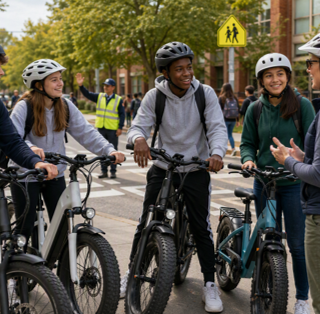
Buy a helmet designed for e-bike riders. They are built for higher speeds, offer more coverage where it matters and include integrated lights/reflective elements to be seen in traffic. Have a house rule: no helmet, no ride.
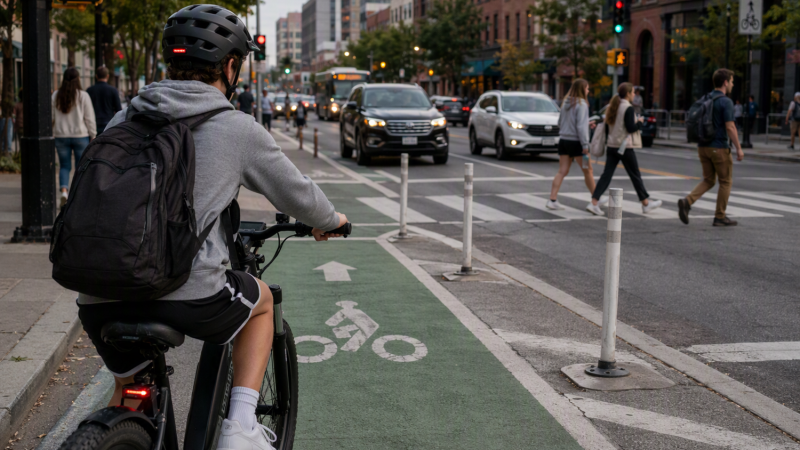
Understand the rules of the road. Obey traffic lights and stop signs. Use bike lanes when available. Yield to pedestrians. Use hand signals and a bell/horn to be seen and heard.
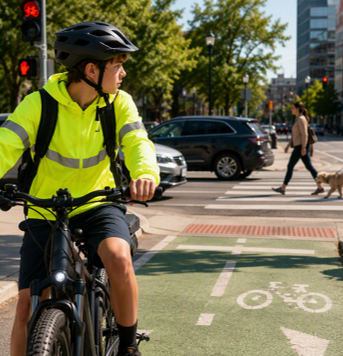
Make sure drivers see you. Make eye contact when crossing streets and entering the lane of travel.
Don’t be a distracted driver. Pay attention to your surroundings. No phones or earbuds while riding.
Wear bright clothing and closed-toed shoes.
Stop when confused. Choose slower, safer routes.
Look ahead, behind and to both sides before crossing or turning.
Have proper lighting and reflective clothes if riding before sunrise or after sunset.
Reduce your child’s risk of a head injury by requiring he/she wear an e-bike specific helmet and bright or reflective clothes.
Inside Children’s is an online community that provides inspirational patient and staff stories as well as information about health and parenting, hospital news, fundraising events and more.