Feeling overwhelmed by conflicting health information? You’re not alone.
Kathy Johnson - Senior Corporate Communications Specialist
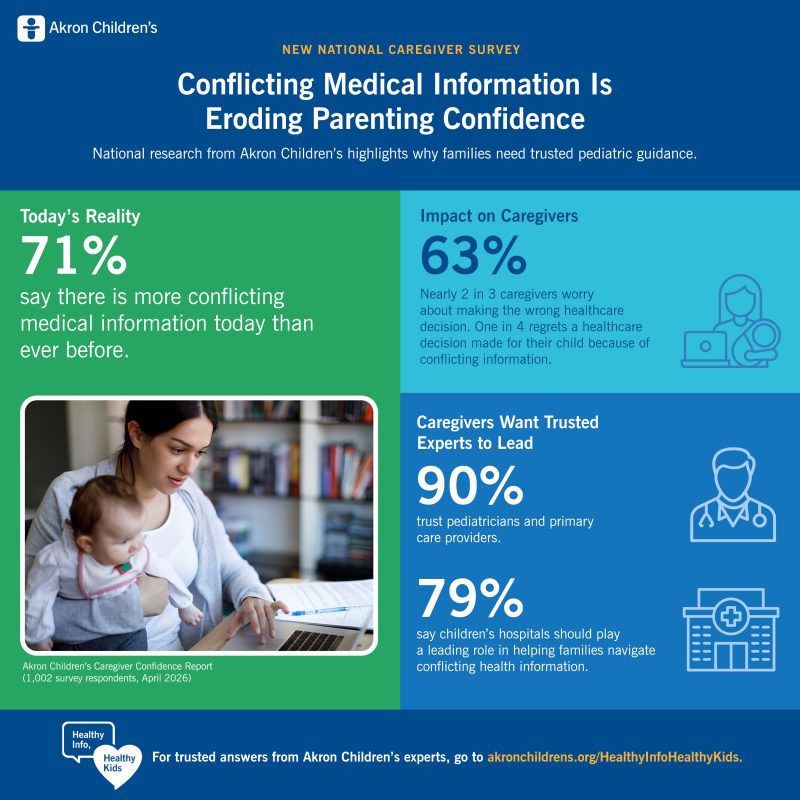
In April, Akron Children’s conducted a national survey of 1,002 parents and caregivers and found that 71% believe there is more conflicting medical information today than ever before. And that uncertainty is having a real impact on how some families make healthcare decisions for their children.
If you’ve ever searched online for answers about your child’s health and ended up feeling more confused than when you started, you’re not alone.
You read one article. Then another. You hear advice from a friend, see a social media post or ask AI a question. Before long, you’re getting different answers to the same concern and wondering which information you can trust.
That uncertainty is taking a toll on families. Nearly two-thirds of caregivers worry about making the wrong healthcare decision for their child, and more than half say conflicting information causes them to second-guess their instincts as a caregiver.
“It’s easy to understand why caregivers feel overwhelmed,” said Shefali Mahesh, MD, pediatrician in chief at Akron Children’s. “Parents are constantly trying to make the best decisions for their children while sorting through an enormous amount of information from many different sources.”
Dr. Shefali Mahesh
When health information conflicts
Today’s caregivers have access to more health information than any generation before them.
Health websites, patient portals, social media, online communities and AI tools can all provide information in seconds. While access to information can be helpful, it can also make it harder to know which sources are trustworthy and how information applies to your child’s unique situation.
According to the survey, 61% of caregivers say it’s difficult to know which medical information to trust.
For Dr. Mahesh, one finding stood out in particular: 54% of caregivers said conflicting information causes them to second-guess their instincts.
“In pediatrics, parents’ observations are incredibly important,” she said. “Parents know their children best, and when they’re receiving conflicting information from different places, it can make an already difficult decision feel even harder.”
Akron Children’s conducted the survey to better understand how caregivers are navigating today’s health information environment and, ultimately, how a children’s hospital can help.
Questions are normal
One of the clearest messages from the survey is that caregivers are trying to make thoughtful decisions for their children.
When information conflicts, it’s natural to have questions.
“Parents care deeply about making the right decisions for their children,” Dr. Mahesh said. “When they’re sorting through different opinions and information sources, they want reassurance that they’re making the best choice for their child.”
That’s where a trusted provider relationship can make a difference. When questions arise, having someone who knows your child and your family’s health history can help bring clarity and confidence to healthcare decisions.
Nearly two-thirds of caregivers worry about making the wrong healthcare decision for their child, and more than half say conflicting information causes them to second-guess their instincts as a caregiver.
How to navigate conflicting health information
If you’re feeling overwhelmed, you’re not alone. The survey found many caregivers are struggling to know which health information to trust. When you’re getting different answers from different sources, Dr. Mahesh shared these five tips for caregivers:
Take a pause before reacting. It’s easy to feel anxious when you read something concerning about your child’s health. Before making a decision, take a moment to slow down and gather more information.
Consider the source. Ask yourself:
Who created this information?
Is it backed by medical expertise or research?
Is the goal to inform or to persuade?
Look for information that explains the “why.” Trusted health information should be transparent about where recommendations come from and the evidence behind them. If you’re unsure, look for information that is backed by medical research and explained in a clear, easy-to-understand way.
Bring your questions to your child’s healthcare team. You don’t need to have all the answers before your appointment. In fact, bringing questions is encouraged. Your child’s healthcare team can help explain what information is accurate, what may be missing context and how it relates to your child’s specific situation.
Trust your observations. No one knows your child better than you do. If something doesn’t seem right, speak up. Parents and caregivers play an important role in their child’s health, and your concerns matter.
Healthy Info, Healthy Kids
The survey makes one thing clear: Caregivers are doing their best to make informed decisions for their children while navigating more health information than ever before.
When questions arise, having access to trusted information can help bring clarity and confidence to those decisions.
That’s why Akron Children’s launched Healthy Info, Healthy Kids, an initiative designed to help families navigate children’s health information through expert perspectives, practical guidance and answers to common questions.
Whether you’re looking for information about vaccines, nutrition, mental health, common illnesses or other children’s health topics, Healthy Info, Healthy Kids offers trusted guidance from pediatric experts to help you make informed decisions with confidence.
Visit Healthy Info, Healthy Kids to explore resources and answers to the questions families are asking every day.
About Kathy Johnson - Senior Corporate Communications Specialist
Kathy Johnson is a northeast Ohio-based freelance writer, editor and public relations consultant with over 25 years of experience in the healthcare industry. She writes extensively for blogs, websites, newsletters and magazines. Since 1999, she has been the principal at New View Communications serving a variety of hospitals and healthcare-related clients.
Inside Children’s
Inside Children’s is an online community that provides inspirational patient and staff stories as well as information about health and parenting, hospital news, fundraising events and more.