Home > Inside Blog > Patient Stories > Teen dancer’s sudden seizure leads to lifesaving autoimmune encephalitis diagnosis
Teen dancer’s sudden seizure leads to lifesaving autoimmune encephalitis diagnosis
Kathy Johnson - Senior Corporate Communications Specialist
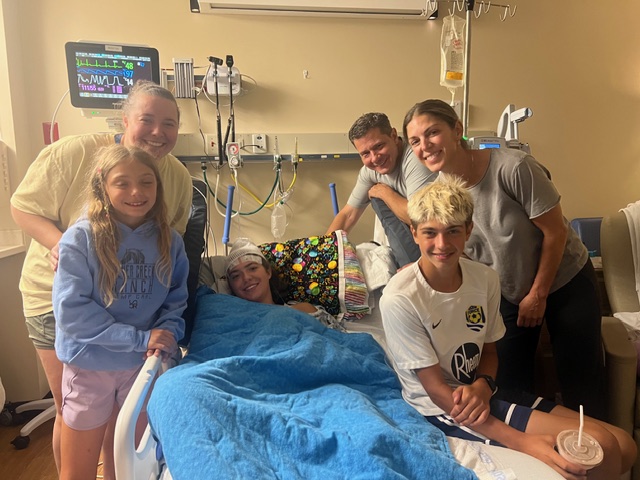
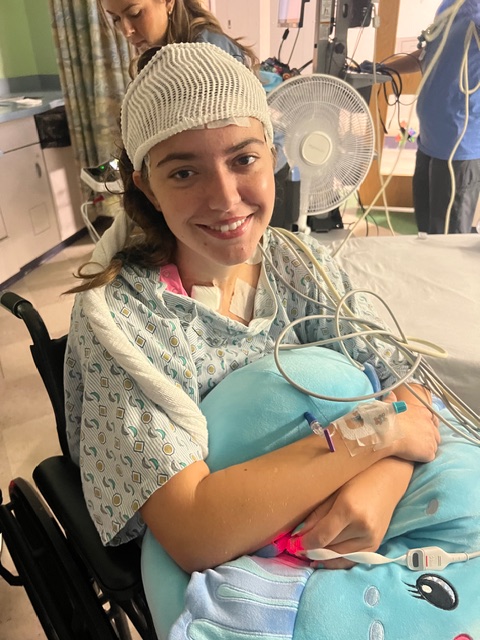
Grey Griggy spent her 15th birthday at Akron Children’s while undergoing treatment for autoimmune encephalitis.
On the morning of July 22, 2025, 14-year-old Grey Griggy woke up dizzy, vomiting and unable to walk. Her mom, Stacey, tried to keep things calm as they sat down to watch a movie together. But during a simple conversation about what to watch, Stacey noticed something alarming.
“She was describing the movie she wanted to watch, and I knew she meant ‘Hocus Pocus,’ but she kept insisting that wasn’t the movie,” Stacey said. “It was clear something wasn’t right.”
Moments later, Grey suffered a tonic-clonic seizure. An ambulance rushed her to Akron Children’s.
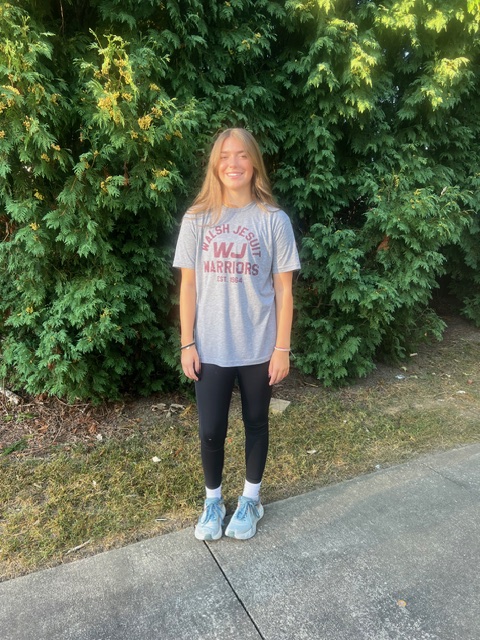
Only weeks earlier, she had been celebrating her eighth-grade graduation from Spring Garden Waldorf School and looking forward to starting high school at Walsh Jesuit that fall.
Grey traveled to Seattle with her family for her brother’s soccer tournament, but wasn’t feeling well for most of the trip.
Subtle signs something wasn’t right
As summer progressed, Stacey began noticing subtle changes in her daughter.
“She didn’t feel well most of the time and was sleeping a lot. I chalked it up to being a teen,” she said. “We went to Seattle for a soccer tournament for Grey’s brother and hiked Mount Rainier, and Grey wasn’t herself.”
Shortly after returning home, Grey developed a high fever that lasted 4 to 5 days. When the fever finally broke, it seemed like she was getting better. On July 21, she even went to the mall to shop for her new school uniform.
By the next morning, everything had changed.
Prior to getting sick, Grey recently graduated from eighth grade at Spring Garden Waldorf School and was looking forward to starting high school at Walsh Jesuit.
A sudden seizure changes everything
After being evaluated in the ER, Grey was transferred to the Pediatric Intensive Care Unit (PICU), where she remained unresponsive.
“We were very fortunate Dr. Ian Rossman, pediatric neurologist, was on duty that day because he was fairly certain she had autoimmune encephalitis,” Stacey said.
Doctors suspect autoimmune encephalitis
Autoimmune encephalitis is a rare but serious condition in which the immune system mistakenly attacks the brain, causing inflammation that can lead to seizures, confusion and other neurological symptoms.
A moment that gave her family hope
For days Grey remained unresponsive, leaving her family unsure if she would wake up. Then one moment brought a glimmer of hope.
“Her stepsister was visiting and leaned over to kiss her head and tell her she loved her,” Stacey said. “Grey responded back that she loved her too and wondered why she was crying.
“That’s when we knew Grey was still in there. It was still her,” she added.
After regaining consciousness, Grey was transferred to a medical floor but had to be transferred back to the PICU when she began experiencing uncontrollable seizures.
Grey also started hallucinating and could sense when seizures were about to happen, which made the experience more frightening.
Grey suffered from hallucinations and could sense when a seizure was about to happen.
A treatment that finally worked
Doctors began a plasma exchange treatment, which helps remove harmful antibodies from her blood, along with a potent sedative to help keep her calm. The treatment worked.
“We never figured out the antibody that was responsible for the encephalitis, but she responded to treatment,” Stacey said.
Supporting Grey’s physical and emotional recovery
As Grey slowly improved, her care team focused on helping her recover both physically and emotionally.
“She was getting yoga and massage therapy while in the hospital. They gave her a massage while her IV was being placed, and she didn’t react because she was so relaxed,” Stacey said.
A competitive dancer with New Focus Dance Academy and a member of the dance team at Walsh, Grey tried to stay positive and set a goal early in her recovery.
“The first day she woke up, she set a goal to dance again,” Stacey said.
Grey is a competitive dancer and was able to participate in Walsh dance team’s bid for the state championship 6 months after her hospitalization.
A long road back
Recovery from autoimmune encephalitis can take months, and Grey’s progress has come gradually.
“At first, she couldn’t write a full sentence or do a full day at school. It’s been a long recovery,” Stacey said. “Sometimes her brain won’t rest.”
“She asked me, ‘Am I still going to be smart?’” Stacey said. “She’s a high-achieving student and she values that.”
Today, Grey continues to recover. Her memory is gradually improving, though she still occasionally experiences dizziness, nausea and trouble sleeping.
Stacey, who used to work for Akron Children’s as a nurse, says the compassion and expertise of Grey’s care team made an immeasurable difference for their family.
“Dr. Rossman is incredible,” she said. “Since my husband is nonclinical, he didn’t understand a lot of what was going on and he was very on edge. Dr. Rossman was so good with him.”
Celebrating milestones
Stacey is also grateful to all of Grey’s nurses on 7100 and the PICU, critical care intensivist Dr. Meredith Broberg and pediatric psychologist Dr. Nicole Swain, who helped Grey manage the stress and anxiety of her condition.
Grey is now back in school and dancing again. Just 6 months after her hospitalization, she helped her dance team at Walsh Jesuit win a state championship – a milestone that once felt impossible.
For Stacey, the entire experience reinforced how quickly life can change – and how grateful their family is for the care Grey received.
“We had all the right people in all the right places,” she said. “She was treated quickly, and we will always be grateful for that.”
Akron Children’s is ranked among one of the best children’s hospitals in the country for pediatric neurology and neurosurgery, according to U.S. News & World Report.
About Kathy Johnson - Senior Corporate Communications Specialist
Kathy Johnson is a northeast Ohio-based freelance writer, editor and public relations consultant with over 25 years of experience in the healthcare industry. She writes extensively for blogs, websites, newsletters and magazines. Since 1999, she has been the principal at New View Communications serving a variety of hospitals and healthcare-related clients.
Inside Children’s
Inside Children’s is an online community that provides inspirational patient and staff stories as well as information about health and parenting, hospital news, fundraising events and more.