Look out for medical misinformation, so you can make safe health care choices for your child.
False health information can spread fast. When this happens, it can be hard to find science-based facts. This can cause parents to make unsafe choices for their children, like skipping vaccines that are known to work or trying a treatment or therapy that isn’t proven by science.
Five tips to manage medical misinformation
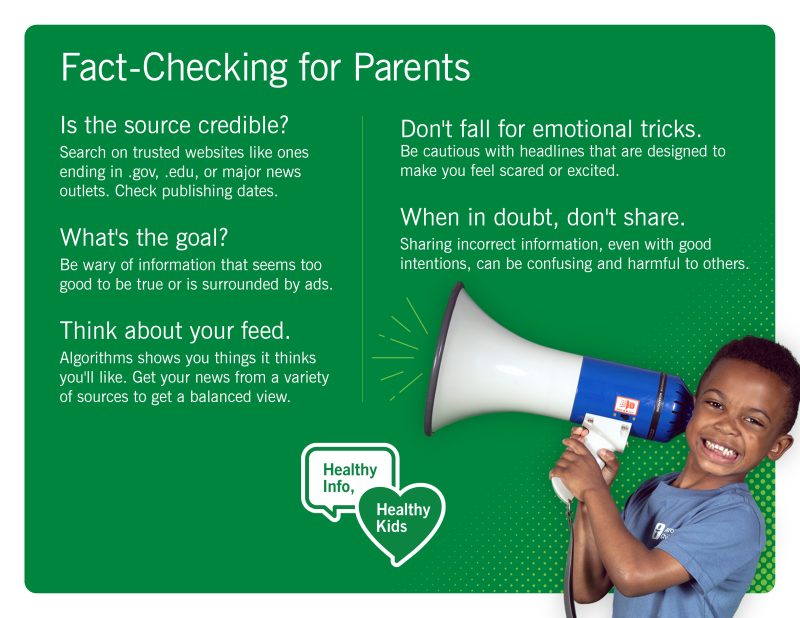
Akron Children’s recently launched the “Healthy Info, Healthy Kids” campaign to reduce the spread of medical misinformation. Pediatrician in Chief Dr. Shefali Mahesh shares these 5 tips to help parents manage medical misinformation and protect their kids.
- Think carefully about where the information comes from. Who wrote it? When was it written? Try searching for the topic online to see if trusted websites have details on it.
- Ask yourself what the intent is. Does the website have ads that are trying to sell you something? Does the information seem too good to be true? If it seems too good to be true, it probably is.
- Remember that artificial intelligence algorithms show you certain things based on what you clicked on before. Try to get your news and information from different places instead of just one website or app.
- Watch out for messages that try to make you feel scared or super excited. Emotional stories are often used in fake health information, and they’re probably not backed by science.
- If you’re not sure the information is correct, don’t share it. Even if you mean well, sharing wrong info can confuse or hurt others.

Dr. Shefali Mahesh
“Misinformation often includes a story to generate an emotional reaction, whereas most legitimate scientific information is rather boring,” Dr. Mahesh said. “If you read something and get riled up, take a moment to verify the science behind it with a trusted source before reacting. If the information source offers a ‘solution’ to a problem, that can also be a red flag.”
Dr. Mahesh says it’s OK to look online for health information, but talk to your child’s doctor before making any decisions. “Your health care team is here to help,” she said. “We can take the general information you read online – and interpret it in the context of your child and their specific symptoms. Parents and health care professionals can work together to ensure kids are getting the best possible care.”
Learn more about medical misinformation and why it can be dangerous.