Drs. Jenna Smarzinski and Jonathan Pelletier at the AAP National Conference in San Diego in early October.
Respiratory syncytial virus (RSV), the most common cause of bronchiolitis, is the leading cause of hospitalization among U.S. infants. Infants and toddlers with congenital heart disease (CHD) are at even higher risk.
Dr. Jenna Smarzinski, a second-year pediatrics resident at Akron Children’s, presented research at the American Academy of Pediatrics (AAP) National Conference & Exhibition in San Diego in early October. The research makes a strong case for changing federal policy so that children with CHD receive a dose of a highly effective monoclonal antibody, which works much like a vaccine, during their second RSV season as well as their first.
She won first place for the 2026 Young Investigator Award from the AAP Section on Cardiology and Cardiac Surgery for her podium presentation.
Beyfortus® (nirsevimab) provides long-acting protection against RSV and greatly reduces costly hospitalizations, but current Centers for Disease Control and Prevention (CDC) recommendations do not cover children with CHD beyond their first RSV season.
“This study has the potential to change national policy on RSV prevention in children with CHD,” said Dr. Michael Forbes, chief scientific advisor at Akron Children’s. “It’s a massive win for Jenna and Akron Children’s, as there were more than 200 abstracts submitted to the AAP Section on Cardiology and Cardiac Surgery. She was up against medical students, residents, cardiology fellows, and even some early-career attendings from top institutions in the U.S. and around the world.”
Akron Children’s pediatric intensivist Dr. Jonathan Pelletier was Dr. Smarzinski’s mentor. Other members of the research team included Drs. Tara Karamlou (Cincinnati Children’s and Akron Children’s), Danielle Maholtz (Akron Children’s), Heather Wojton (Akron Children’s), Kailey Remien (Nationwide Children’s), Todd Karsies (Nationwide Children’s), Michelle Ramirez (Hassenfeld Children’s Hospital at NYU Langone) and Sarah Rush (Akron Children’s).
Background
Synagis®, which required a monthly shot, was the first monoclonal antibody for RSV approved by the FDA.
Beginning in 2023, it was replaced by Beyfortus, a one-time injection that provides protection for a whole season. Synagis was discontinued in the U.S. at the end of 2025.
When the long-acting shot became available, neither the AAP nor the CDC included kids with CHD among the high-risk groups recommended for a second-season dose.
That changed in September 2026. The AAP now recommends the shot for all babies in their first RSV season, and for children at higher risk, including many with serious heart defects, in their second RSV season too.
But the CDC, whose recommendations influence insurance coverage, currently differs from the AAP on this issue.
The CDC recommends Beyfortus for all infants in their first RSV season and for high-risk children in their second season. However, CHD is not one of the CDC’s high-risk criteria for a second-season dose.
“What is the right thing to do for these children?” Dr. Pelletier said.
He thought the team could provide data to help answer that question.
For the study, the researchers looked at the association between Beyfortus and RSV-associated hospitalizations in children with no risk factors and children with CHD during their first RSV season, then compared the two groups’ risk of RSV hospitalization during their second season.
Using data from Epic Cosmos, a multi-center electronic health record (EHR) database of more than 300 million patients, the researchers looked at the outcomes of more than 1 million infants born between April 2023 and March 2026 who either received Beyfortus within 30 days of the start of RSV season or received no RSV prevention.
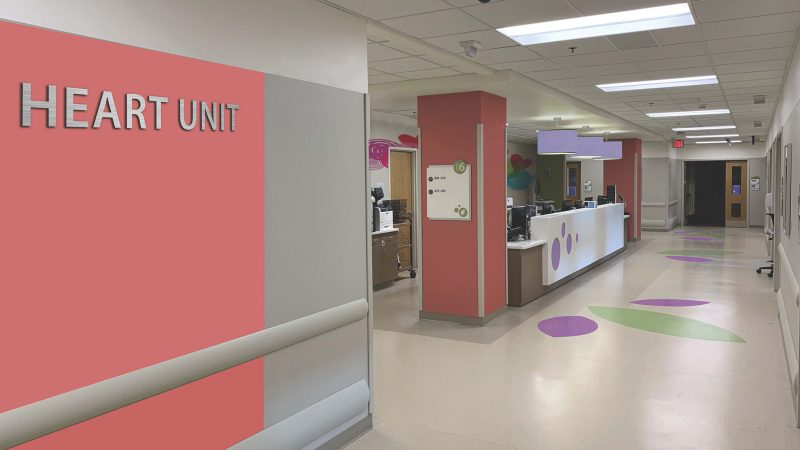
Akron Children’s opened a dedicated heart unit within its PICU in 2025.
The findings
“During their first RSV season, kids with CHD were at approximately triple the risk of children without CHD for being hospitalized with RSV,” said Dr. Pelletier.
They found Beyfortus substantially lowered the risk of RSV hospitalization in both groups.
Kids with no risk factors who received Beyfortus had about a 70% lower risk of RSV hospitalization than those who did not, and kids with CHD had about a 60% lower risk.
The data showed that they would need to administer about 94 Beyfortus shots to prevent one hospital admission among kids with no risk factors, compared to only 37 shots to prevent one admission among children with CHD.
As they tracked the children over their second RSV season, they found the kids with CHD continued to have an elevated risk of RSV hospitalization.
Without Beyfortus, children with no risk factors had about a half percent chance of being hospitalized with RSV during their second season, compared to a 1.6% chance during their first season. But for children with CHD, the risk of RSV hospitalization during their second season was 1.8%. This is much lower than the 4.8% risk during their first RSV season, but still higher than the first-season risk of children with no risk factors (who are covered by current CDC recommendations).
“The data show we should be supporting these kids with CHD during their second RSV season,” said Dr. Smarzinski, who plans to become a pediatric cardiologist.
The researchers believe the findings make a strong case for the CDC to add CHD to its second-season criteria, and for further study of how well a second-season dose protects these children.
“It really is important for us to use this opportunity to talk to policymakers and consider whether we might be able to get the CDC recommendations changed to align with the AAP,” said Dr. Pelletier.
The list price of Beyfortus is about $550 a dose. A 2023 study of Medicaid claims found that an RSV hospitalization costs an average of about $14,000 for infants overall and about $23,000 for infants with CHD.
“So for kids with CHD in their first season, Beyfortus roughly pays for itself on hospital costs alone,” said Dr. Pelletier. “The 37 doses it takes to prevent one admission cost about $20,000, and that one admission costs about $23,000. That’s only the direct healthcare costs. You also need to include all the downstream costs that these families accrue. There’s the parents’ time off from work, the separation from siblings, and all the stress and worry they endure during a young child’s hospitalization.”
Inside Children’s is an online community that provides inspirational patient and staff stories as well as information about health and parenting, hospital news, fundraising events and more.