Cutting the ribbon to open the new unit are (L to R) Marci Matthews; Dr. Jason Spivey; Jerry and Maria Welty; Akron Children’s President and CEO Chris Gessner; Rennick and Dr. Monica Andreoli; and Laurice Moore and Lisa Jeffries, representing the Akron Children’s Women’s Board.
With the new inpatient behavioral health unit, Akron Children’s took a huge step forward in meeting the demand for the highest levels of behavioral healthcare for patients ages 5 to up to 18.
The previous, 24-bed unit moved from the eighth floor of the main hospital building. Now located on the fifth floor of Kay Jewelers Pavilion, the new unit has 30 beds. Ultimately, there’s space to expand to 40 beds.
The planning for the unit move and expansion has been in the works for several years.
Improving delivery of inpatient behavioral healthcare
“The new unit not only expands Akron Children’s capacity for inpatient behavioral healthcare, but it reshapes how that care is delivered,” said Dr. Eva Szigethy, the Lois C. Orr Endowed Chair in Pediatric Psychiatry at Akron Children’s.
“This unit offers much more than a larger space with more beds,” she said. “It’s really reengineering how we provide behavioral healthcare and how we train staff to optimize the safety of our patients in a therapeutic environment.”
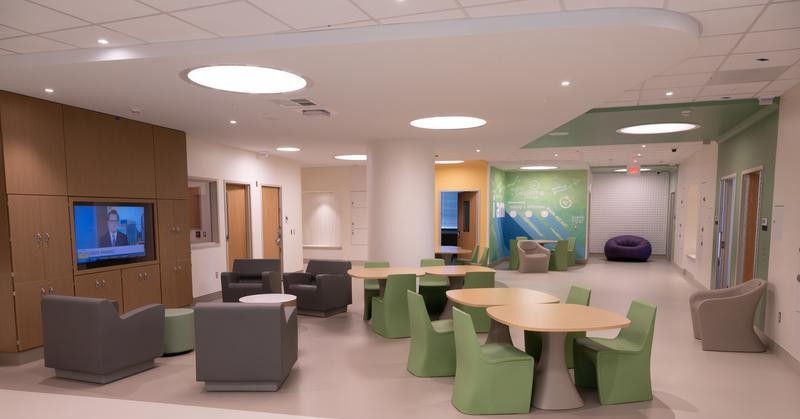
Group activity space in Akron Children’s inpatient behavioral health unit.
The new unit features a tiered hospitalization experience with different “subunits.” Based on the diagnosis and the level of support needed, staff will assign the patient to a regular acute care unit, high acute care unit or the new crisis stabilization unit.
“The crisis stabilization unit provides a brief, intensive crisis management for kids who require a short hospitalization, averaging three to four days,” said Dr. Jason Spivey Sr., vice chair of behavioral health at Akron Children’s. “This will offer a new care pathway for patients often seen in the emergency room (ER) who don’t require a long stay for treatment. As the name suggests, the objective is truly to give the child and family the crisis management skills they need as well as a few days to prepare at home.”
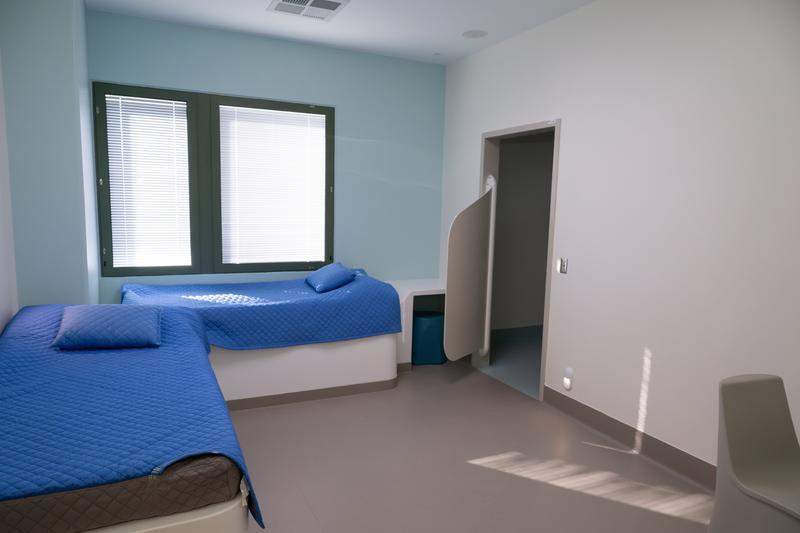
A crisis stabilization room, where parents can stay with their child and be a full part of therapy.
Parents will be connected to resources at Akron Children’s or in the community. Plus, they will learn how to safe-proof their house, get extra support for their child in school and benefit from more intensive parent training.
Design elements and activities promote healing
Donna Koterba, director of inpatient behavioral health, said the unit’s design uses therapeutic architecture, incorporating color and natural light in ways that have been shown to reduce stress and promote healing.
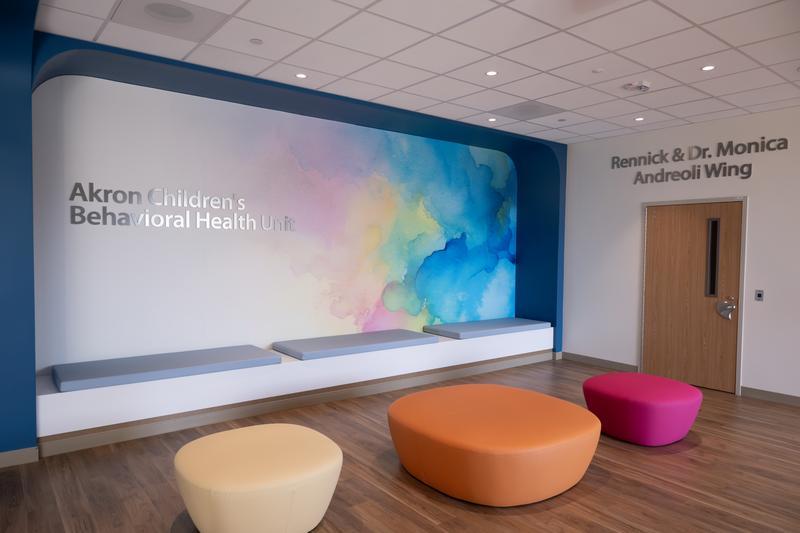
The family reception room in Akron Children’s new inpatient behavioral health unit.
It features a spacious gym for structured group activities and exercise, a multimedia room, a sensory stimulation room and a large outdoor space.
Growing need for behavioral healthcare
Like all children’s hospitals, Akron Children’s has seen behavioral health emerge as one of the most in-demand services over the past few decades.
One in four Akron Children’s pediatric primary care visits involves a behavioral health concern.
Over the past year, more than 4,500 youth received care in the Akron Children’s ER for a behavioral health concern.
Even with an integrated behavioral health model, the average wait time to see a therapist is still more than two months.
“We’ve spent years building a model of care that integrates behavioral health into primary care. We’re meeting children and families where they are already showing up and helping patients reach the right level of care at the right time,” said Dr. Szigethy.
The expanded and updated inpatient unit gives the team new tools for treatment and new hope for families and young people in the region struggling with anxiety, depression and other behavioral health challenges.
Inside Children’s is an online community that provides inspirational patient and staff stories as well as information about health and parenting, hospital news, fundraising events and more.