The Behavioral Health team completed a leadership program at Hope Meadows, which offers equine-assisted mental health counseling and wellness programs. The group got so much out of the program that they incorporated equine therapy into patient care.
“Hope Meadows’ trained behavioral health counselors help kids build confidence and improve their mental health,” said Meredith Strassburger, Akron Children’s Behavioral Health program director. “Our patients learn coping skills, self-regulation, and ways to build trust and teamwork – all through horse-related activities that are both fun and valuable.”
Good candidates for equine therapy
Rihab Mohamed, MD, Akron Children’s child and adolescent psychiatrist, helps the Behavioral Health team identify patients who would benefit from equine therapy. “Equine-assisted therapy is particularly beneficial for patients who are resistant to traditional forms of therapy, whether because of anxiety or the stigma they associate with receiving mental health treatment and feeling ‘different’ from their peers,” she said. “Many enjoy being part of a group at Hope Meadows, where they can participate in an outdoor activity that feels engaging and natural rather than like a clinical therapy session.”
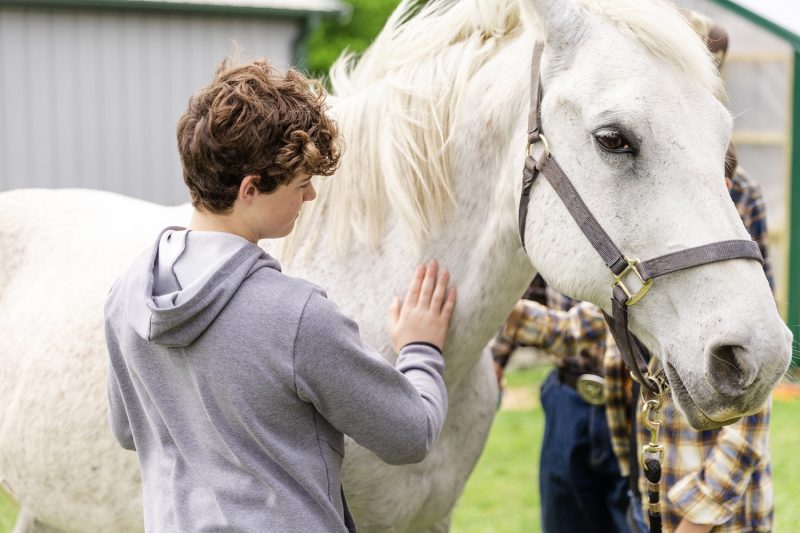
The kids engage in therapeutic activities and interventions with horses from the ground, creating opportunities for connection, self-discovery and healing. While sessions do not include riding, participants develop meaningful bonds with the horses. “The participants know they’re going to see ‘their’ horse each week,” Meredith shared. “They take care of their horse, talk to them and create a special bond.”
Dr. Mohamed says horses are very attuned to humans’ social cues. “Horses can sense whether the people around them are calm or anxious,” she said. “At Hope Meadows, the therapist helps interpret the horse’s behavior and uses those interactions to help children recognize their emotions and develop self-regulation skills.”
The participants groom and lead the horses, looking forward to seeing “their” horses each week.
Parents invited to participate
During the spring 2026 program, parents and guardians attended separate group sessions while the youth worked with the horses. “Many parents said that before coming to Hope Meadows, it was hard to get their kids to attend school or participate in activities outside the home,” said Kate Saucier, Akron Children’s Behavioral Health program director. “After the program, many kids became more willing to leave the house and stay engaged in daily activities. One participant even improved from failing grades in school to earning A’s and B’s.”
The program helps families know they’re not alone. “One parent commented in the satisfaction survey that learning about other families’ experiences made her feel less isolated and overwhelmed,” Kate shared. “Kids feel the same way, too. They know they’re not the only ones with behavioral health concerns. They gain confidence from meeting new peers who share common struggles.”
Measurable improvement
The participants completed anxiety and depression measures before and after the equine therapy. The group’s overall anxiety declined by 19.5%, and their depression decreased by 31%.
They also completed satisfaction questionnaires at the last session, and all kids commented that the Hope Meadows program helped them. They noted improvements such as being more confident speaking up, talking to others, being more open and learning how to stay calm even when they are angry.
Attendance has ranged from 8-11 kids in each of the four sessions held so far. The Behavioral Health Fund of the Akron Children’s Foundation, which is supported through donations, covers the cost of the program.
Collaboration will continue
“We are fortunate to partner with Hope Meadows, offering patients an excellent and close-to-home therapy opportunity with horses,” said Eva Szigethy, MD, PhD, Lois C. Orr Chair of Psychiatry and Behavioral Health. “We have seen our patients thrive and build upon their learnings and positive experiences fostered from the program. As a result of this ongoing success, we plan to continue to make Hope Meadows available to our patients at least two times per year.”
Inside Children’s is an online community that provides inspirational patient and staff stories as well as information about health and parenting, hospital news, fundraising events and more.