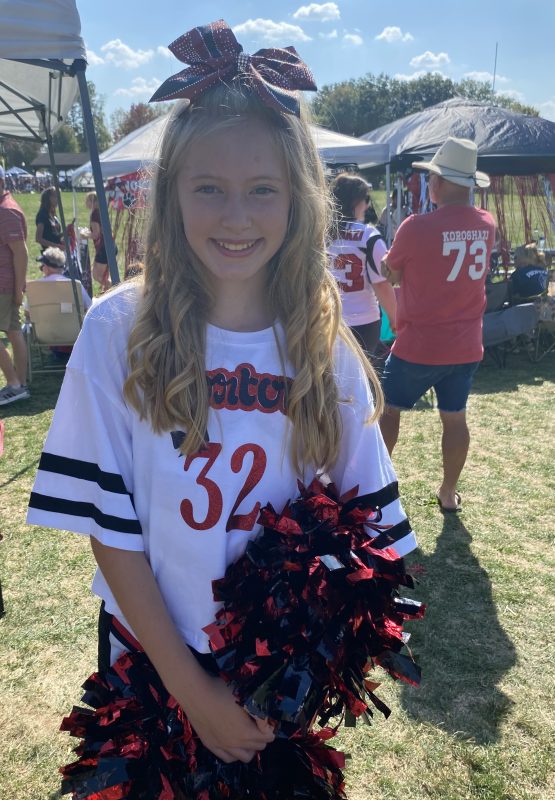
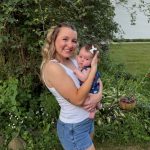
Gwen has resumed an active life after successful vertebral body tethering surgery.
Spinal fusion surgery has long been the gold standard for treating severe scoliosis. But pediatric orthopedic surgeons at Akron Children’s have been finding success with a new surgical technique that holds the promise of preserving the child’s spinal range of motion. This could make a difference for future participation in dance, gymnastics, diving, cheerleading and other activities that require considerable flexibility.
Vertebral body tethering (VBT) is only an option for a subset of pediatric patients with scoliosis – those who still have significant growing to do. It can be offered as a hybrid option for some patients in conjunction with spinal fusion.
Norton cheerleader thrives after hybrid surgery option
The hybrid approach proved to be a great option for Gwendolyn “Gwen” Stine. The Norton middle school cheerleader underwent the 2 procedures back-to-back on the same day in October 2025 at age 11. Within 6 weeks, she was back to school, practicing singing and dancing for her school musical. She has even returned to cheerleading – mounts, jumps and cartwheels.
VBT is a “growth modulation” treatment. It uses anchors attached to vertebrae on the side of the spine that curves outward and an attached flexible tether to guide the spine into upright alignment. VBT is minimally invasive compared to spinal fusion.
Pediatric orthopedic surgeon Dr. Todd Ritzman began seeing Gwen when she was diagnosed at age 5 with scoliosis. Despite wearing a brace for 7 years, Gwen’s scoliosis worsened as she approached puberty. Her curve was now in surgical range.
“Gwen experienced back pain on a daily basis,” said her mother, Joelle.
The family wanted to be as knowledgeable as possible about their treatment options.
Gwen and Joelle have been involved with the scoliosis peer support group, Curvy Girls, since her initial diagnosis. In fact, Gwen is the leader of the Cleveland chapter. They both attend chapter meetings and national conferences to exchange information with other patient families.
“That’s one of the reasons I love Dr. Ritzman,” said Joelle. “I would ask him about a study I learned of through this group, and he would always be aware of it.”
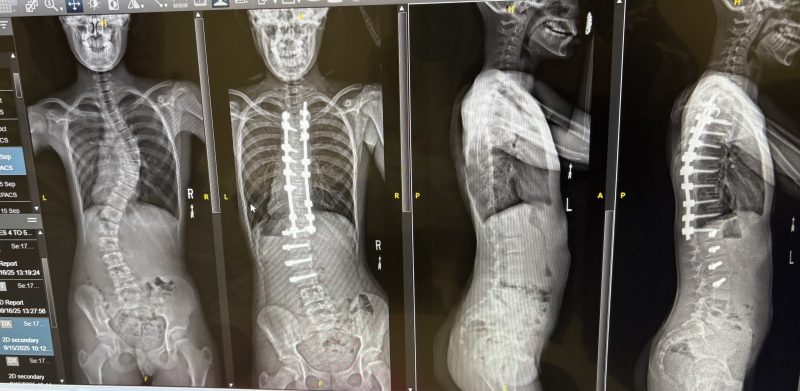
The “S” shape of a scoliosis spine is defined by 2 distinct curves: the thoracic or upper curve and the lumbar or lower curve.
VBT candidates must meet surgical criteria
Patients who still have years to grow and have flexible curves between 45 and 65 degrees could be a candidate for VBT, said Dr. Ritzman. While VBT is a wonderful choice to preserve range of motion, research shows that, in some cases, the tethers do break, fail to correct the curve or overcorrect the curve requiring a second procedure in 15% to 20% of patients.
Dr. Ritzman and his Akron Children’s colleagues Drs. Lorena Floccari and Walter Samora are all full-time pediatric spine surgeons and active members of the Scoliosis Research Society and the Pediatric Spine Study Group. Dr. Ritzman is also a member of the Harms Study Group.
“We are very excited about the hybrid approach,” Dr. Ritzman said. “It combines the best advantages of each approach – the reliability and ability to correct sagittal alignment with posterior fusion of the thoracic spine and the motion preservation and maintenance of ability to perform preoperative activities with vertebral body tethering of the lumbar spine.”
Dr. Ritzman emphasized that each case is different. While preserving motion in the lumbar area is important, so is restoring sagittal alignment of the thoracic spine – or how the spine looks from the side view – because that impacts lung function.
Gwen’s spinal X-rays before and after surgery
Gwen’s surgery and recovery
Doing the procedures at the same time – about 8 hours in Akron Children’s dedicated spine operating room – saved Gwen and her family the anxiety and recovery associated with 2 separate surgeries.
Dr. Ritzman has a pediatric thoracic surgeon join him on these surgeries for an extra level of efficiency and patient safety.
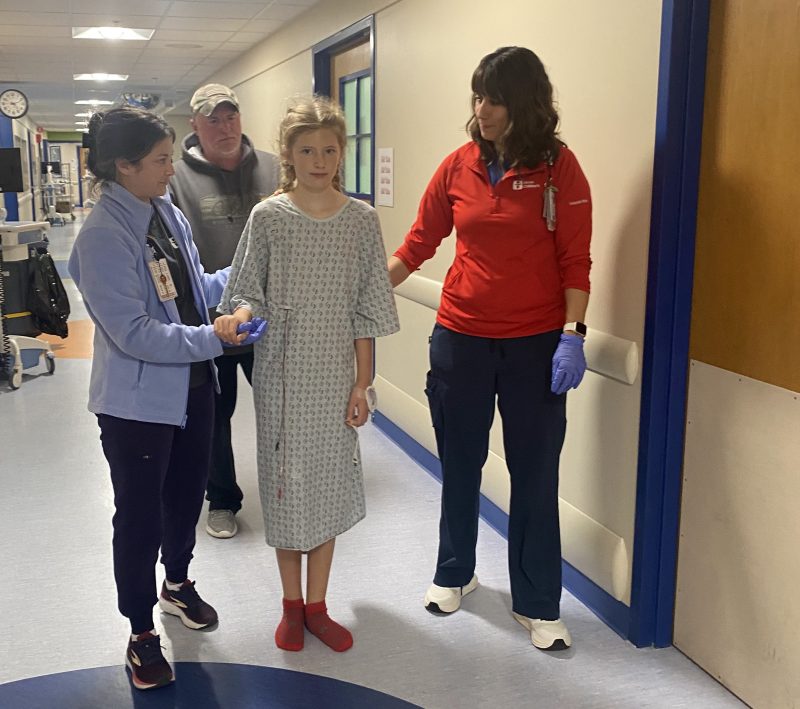
Gwen, taking her first steps post-surgery.
“I spent a few nights in the hospital but was home in my own bed by the fourth day,” said Gwen. “At a follow-up appointment, we asked Dr. Ritzman about restrictions on activities like sports and roller coasters. He said, ‘Go live your life.’”
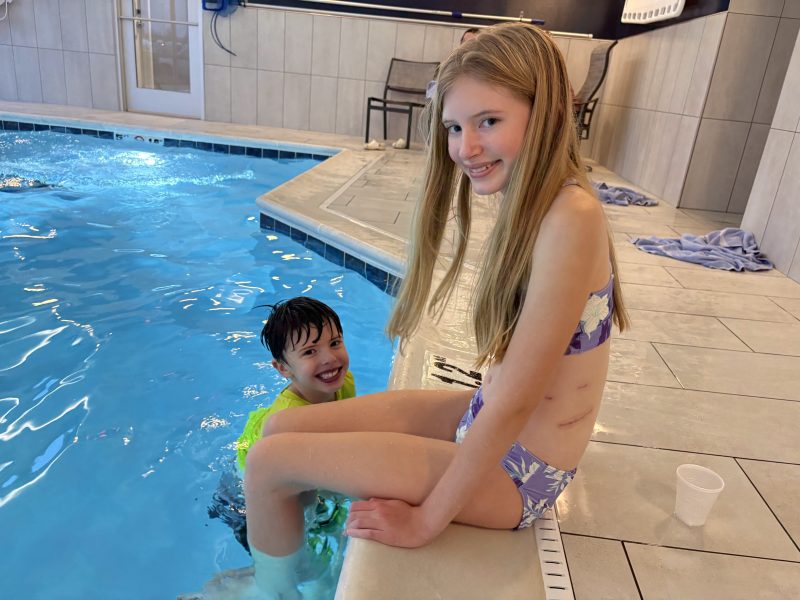
Gwen, swimming six weeks after surgery; VBT scars visible on her side.
“We are thrilled with the outcome,” said Joelle.
As for Gwen, she is doing exactly what Dr. Ritzman said to do. She’s living her life fully at school, with friends and family, and being more active than ever. She also plans to stay involved with Curvy Girls, helping and supporting other girls on their journey with scoliosis.
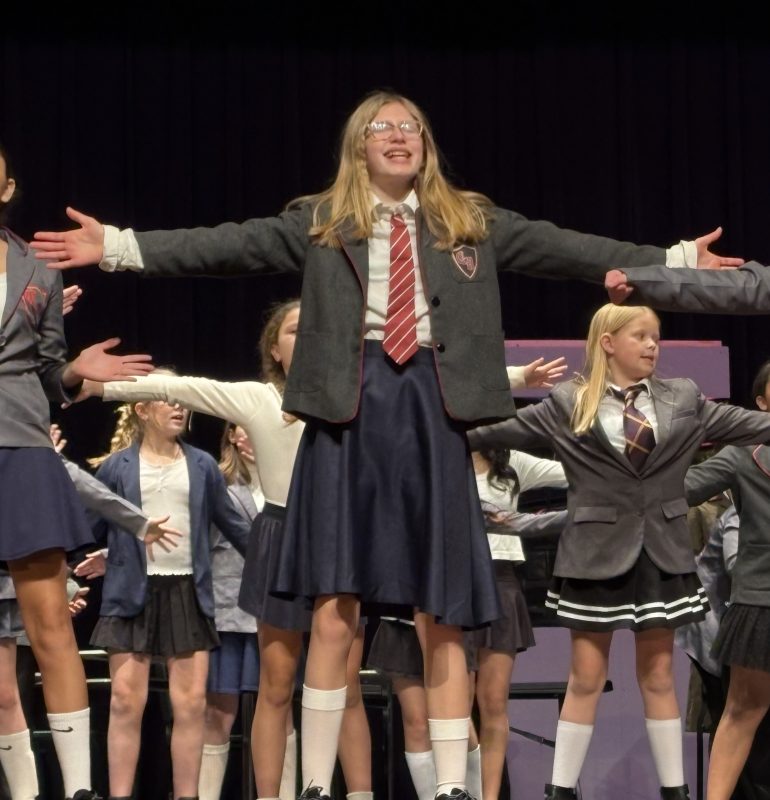
Gwen played Lavender in “Matilda The Musical Jr.” at her school 4 months after her surgery.
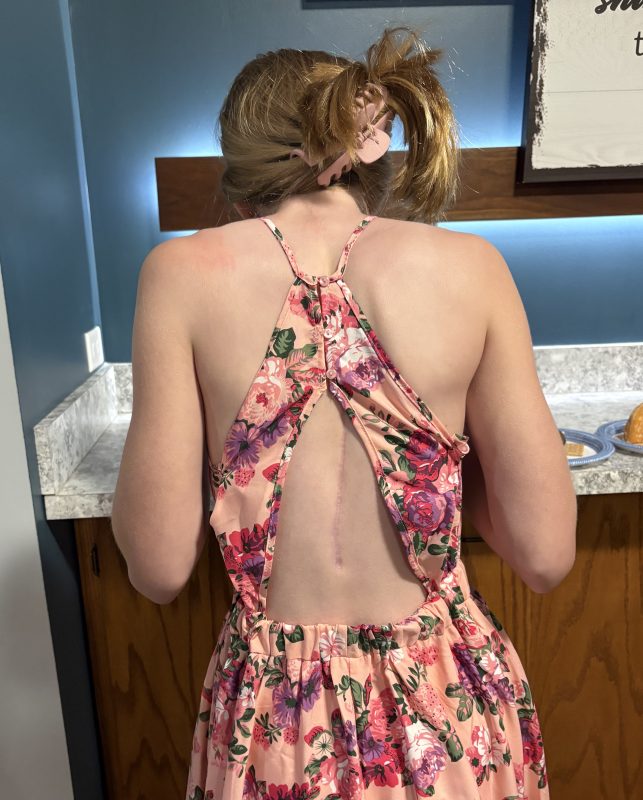
On Easter, Gwen opted to wear an open-back dress to show off her spinal fusion scar.
“It’s a badge of courage,” she said.
Gwen chose an open-back dress on Easter, in part, because she was proud of her spinal fusion scar.
Key takeaways about VBT surgery
It is FDA approved but still considered in an “investigational” phase for pediatrics.
Ideal candidates are growing children who have failed traditional treatments like bracing and who have flexible curves between 45 and 65 degrees.
The treatment uses “growth modulation.” You get some correction with the initial procedure but primarily as the tether restricts growth on the outer (convex) side of the curve while still allowing growth on the inner (concave) side of the curve.
The advantage of this procedure over spinal fusion is it can preserve range of motion, particularly in the lower back.
It is minimally invasive compared to spinal fusion. There will be a quicker recovery. Scars will be smaller and on the side of the body versus the back.
The tether remains in place for life. However, there is a risk it could break, correction is not sufficient and spinal fusion would still be required.
Explore all treatment options before making a decision: “We strive to have thoughtful, informed decision making with families,” said Dr. Ritzman. “We discuss what has the most reliable outcome and where motion preservation is most beneficial.”
Learn more about our Spine Center, and schedule an appointment if you’re concerned about your child having scoliosis.
Inside Children’s is an online community that provides inspirational patient and staff stories as well as information about health and parenting, hospital news, fundraising events and more.