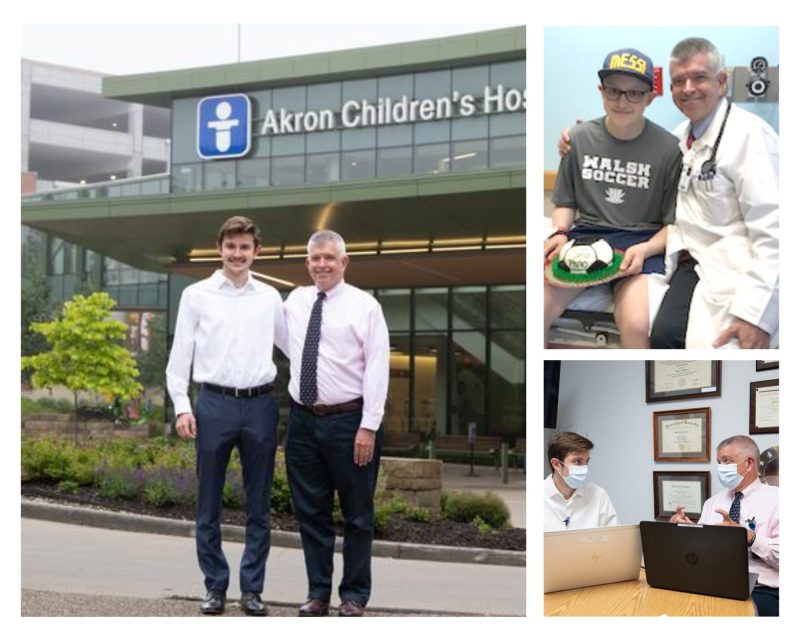
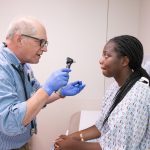
Incoming medical student Pano Tsarouhas doesn’t yet know what type of medicine he wants to practice, but he knows exactly the type of doctor he wants to be. He plans to model his approach to patient care after Dr. Jeff Hord, the pediatric hematologist/oncologist who cared for him during his fight with Ewing’s sarcoma as a teen.
Pano’s path
“I think what I admire most is his style and approach to talking to patients,” said Pano, 22. “He was direct but comforting. He would lay out all the options and walk us through them and yet he would always listen to me. At the end of the day, it’s what the patient wants.”
Pano later shadowed Dr. Hord, conducted research with him and volunteered at the hospital. They co-authored two manuscripts, which were accepted for publication in national journals. Pano will enter the Northeast Ohio Medical University in July.
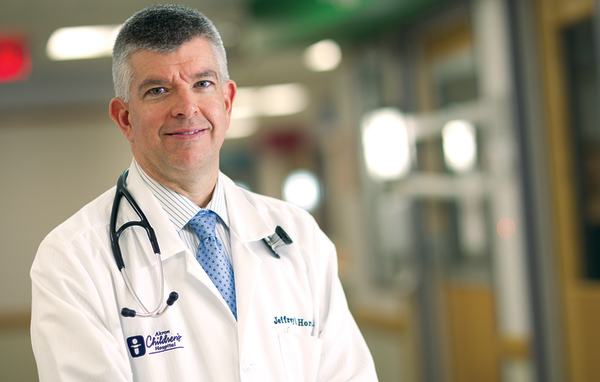
Pano is just one of hundreds of Akron Children’s patients Dr. Hord has touched, directly or indirectly, during his 27-year career as medical director of the Showers Family Center for Childhood Cancer and Blood Disorders. He retires on May 15 with countless accomplishments.
Dr. Hord treated Pano Tsarouhas for childhood cancer and has mentored him over the years. Pano starts medical school this July.
Adding services
When he arrived at Akron Children’s in 1999, after completing his fellowship at Vanderbilt University and directing the sickle cell program at Children’s Hospital of Pittsburgh for 4 years, Dr. Hord was 1 of 3 providers caring for about 45 patients annually. Today, the Showers Center has 10 pediatric hematologist/oncologists (soon to be 12) caring for about 105 patients annually. The department also has 18 advanced practice providers.
That growth corresponded with the hospital adding related subspecialties like neurosurgery to treat brain tumors, but much of it came from the department’s steady addition of needed services.
“If you had a new leukemia patient with a high white count, a process called apheresis is needed. We didn’t have that service and would send the patient elsewhere,” said Dr. Hord. “We very quickly developed that service.”
Over time, the Showers Center expanded a hemostasis and thrombosis center and a stem cell transplant program, while adding a neurofibromatosis clinic, an adolescent and young adult cancer program, and a cancer survivorship program to follow patients for late effects beyond treatment.
Keeping care close to home
Patient volumes also reflect an expanding service area.
When Akron Children’s moved into the Mahoning Valley in 2010, access to cancer care improved greatly for area children.
“Most patients were not getting care in the Mahoning Valley,” said Dr. Hord. “We were seeing some here in Akron, some were going to hospitals in Cleveland and Pittsburgh. Initially, we might have made 6 new diagnoses there per year. Now it is up to 25 to 30.”
Once he built the services and the expertise, Dr. Hord’s goal was to build the reputation of the center – so parents would know that a child treated here would receive the same care, the same access to clinical trials, the same outcomes – as a child treated at any larger, nationally known center.
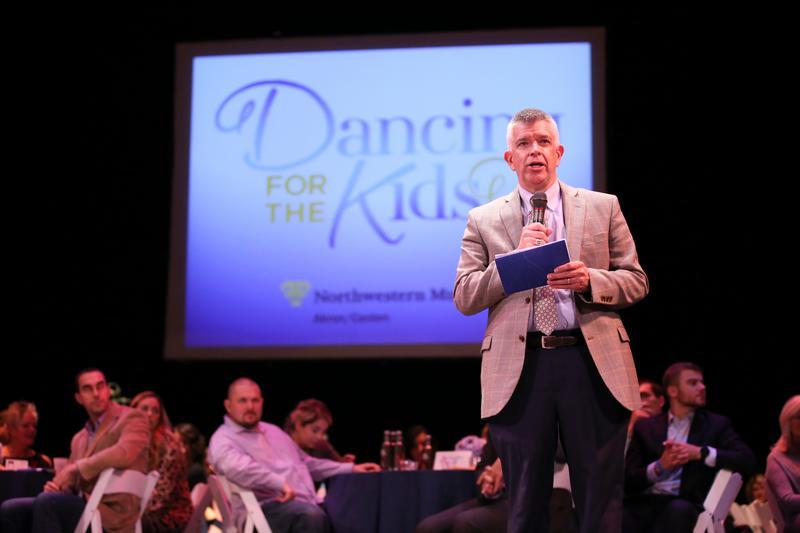
Dr. Hord welcoming guests to “Dancing for the Kids” in 2017, an annual event to raise funds for the Showers Center.
Research and quality: getting the word out
He also wanted to boost Akron Children’s reputation within the profession.
“I’ve tried to support our faculty by developing a fellowship program and being part of national committees and working groups, attending national meetings and submitting research for presentation,” he said. “It’s been personally very rewarding.”
Dr. Hord served on Ohio Department of Health committees addressing policy issues related to sickle cell disease and hemophilia.
When the Children’s Hospital Association became involved in quality improvement, Dr. Hord helped develop a hematology/oncology collaborative. This evolved into a 15-year commitment with the Solutions for Patient Safety initiative, with his focus on reducing central line-associated bloodstream infections.
“This is something every department in the hospital now pays attention to. We have raised awareness that it is a real problem causing illness and even death,” Dr. Hord said.
Dr. Hord has served on countless committees at Akron Children’s and was elected as president of the medical staff midway through his career.
“I attended my first ASPHO meeting as a fellow because my mentor, Dr. John Lukens at Vanderbilt, was the president at the time,” said Dr. Hord. “He would take me around and introduce me to the people who were writing the textbooks I was reading. Then I realized these same people I had put on a pedestal were the same people I could call to ask a question. What made it more interesting, sometimes they would call me about research I was doing or with an opportunity.”
Dr. Hord went on to chair ASPHO’s practice management, education, finance and membership committees, eventually joining the board, serving as treasurer, vice president and eventually president.
“It was always a goal, since going to that first meeting with my mentor as a fellow, to lead that organization, but always with Akron Children’s on my name tag,” he said. “I hope it has markedly increased Akron Children’s as a place known where good pediatric hematology/oncology care is delivered.”
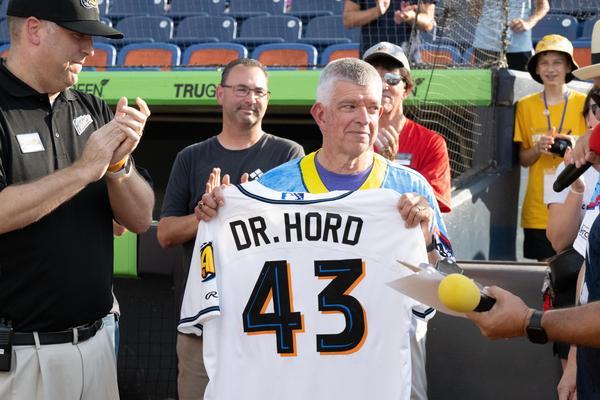
At a 2025 Akron Rubber Ducks game in Canal Park, Dr. Hord was presented with his own jersey at the annual Cancer Survivors’ Night.
Kentucky roots
Dr. Hord grew up in rural Kentucky with no physicians in the family.
In medical school, he was torn between the path of general pediatrics or pediatric hematology/oncology.
“But during my first clinical rotation, my very first patient was a little boy who had leukemia,” he said. “I found it very interesting. It opened up a whole new world for me – seeing the diagnosis, going to the lab, looking at the bone marrow. I saw him get enrolled in a clinical trial. The oncology team there would be following this boy for decades to come. There was continuity of care, which was also something I desired to do.”
Advances in care for childhood cancer
Dr. Hord’s career has aligned with several positive trends in his field. Survival rates, in general, have increased. Doctors are often able to reduce the intensity of the treatment to avoid the lasting effects of chemotherapy and radiation.
“We also have this whole new world of molecular medicine,” he said. “We can characterize a disease more precisely and offer targeted treatments. Now, we have monoclonal antibodies that have been engineered to augment our immune systems to target cancer cells.”
Patient interactions – the thing that means the most
Dr. Hord, who also holds the title of LOPen Charities and Mawaka Family Chair in Pediatric Hematology/Oncology, has lots of plans for travel and volunteering in retirement. But he knows he will miss his staff and patients the most.
Even while he spent most of his hours doing administrative work, Dr. Hord always carved out time for clinical care.
“You know it is the patient contact and relationships – that’s why I went into medicine. When I think back on my career, it will be those interactions that mean the most. And it’s not just the patients who have done well,” said Dr. Hord, pausing as emotions begin to overtake him. “It’s also the patients who didn’t survive. Those families are still so appreciative, and I don’t really know how they can be. But they do appreciate us for being alongside them on that journey.”
Inside Children’s is an online community that provides inspirational patient and staff stories as well as information about health and parenting, hospital news, fundraising events and more.