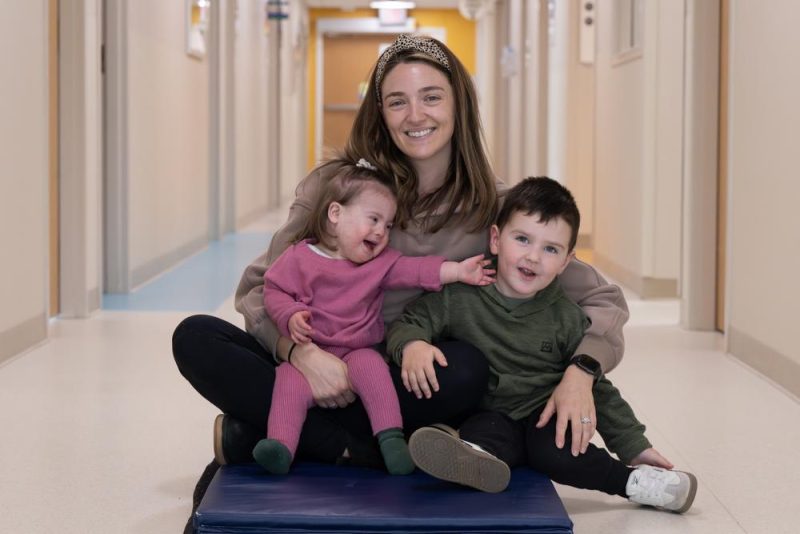
Lindsey, Lenora and Calvin Conway
When Lindsey Conway went in for her 12-week ultrasound for her second child, she didn’t expect anything out of the ordinary. But that quickly changed when doctors spotted something concerning.
“There was a spot on the back of the baby’s neck called a cystic hygroma that’s often associated with chromosomal abnormalities,” Lindsey said. “Because of this, we were encouraged to get further genetic testing.”
Prenatal Down syndrome diagnosis brings unexpected news
A Down syndrome diagnosis came before Lenora was even born.
“We knew we would love her no matter what,” Lindsey said. “But the news was definitely shocking at first.”
At the time, Lindsey and her husband, Corey, were already parents to their healthy 3-year-old son, Calvin. Now they found themselves suddenly navigating unfamiliar territory.
Multiple diagnoses during pregnancy signal a complex medical journey
Throughout her pregnancy, Lindsey was closely followed by the maternal-fetal medicine team at Akron Children’s. Additional testing revealed Lenora would face more than 1 medical challenge.
Fetal heart tests suggested possible atrial septal defects, prompting meetings with specialists to prepare for what might come after birth. She was also diagnosed with duodenal atresia – a condition where part of the intestine doesn’t form properly.
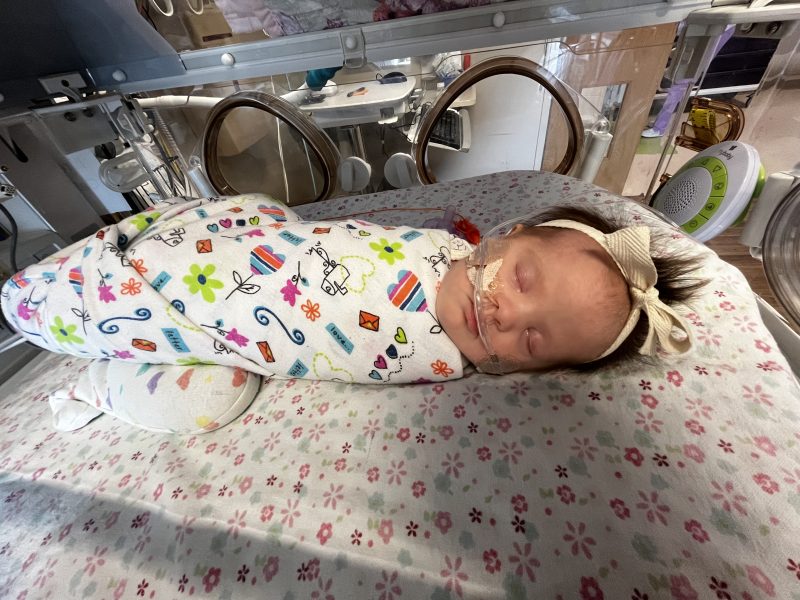
Lenora was born at 32 weeks and spent 64 days in the NICU.
Premature birth at 32 weeks leads to NICU care
At 32 weeks, Lindsey developed excess amniotic fluid, a complication tied to Lenora’s condition. It led to an emergency Cesarean section at Summa Health while her husband was out of town.
Lenora was immediately transferred to the neonatal intensive care unit (NICU) at Akron Children’s. Just 1 day later, she underwent surgery for multiple conditions, including duodenal atresia and a tracheoesophageal fistula which was affecting her airway and esophagus.
For the next 64 days, Lenora remained in the NICU. She required intensive support that included a breathing tube, a PICC line and a feeding tube. There were complications and setbacks along the way, which made recovery more challenging.
For Lindsey, it was an emotional and exhausting time. But it was also where she began to see her daughter’s strength.
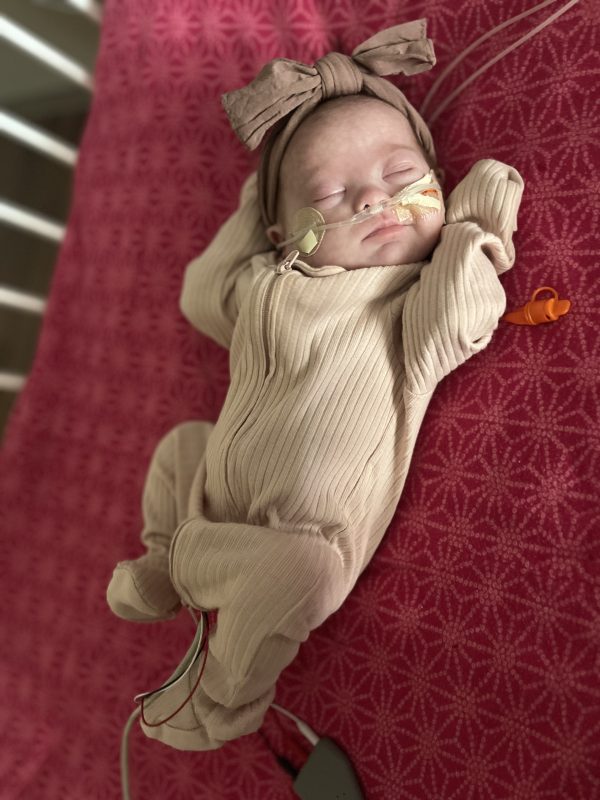
Lenora went home from the hospital with a feeding tube and struggled with frequent vomiting.
Overcoming early developmental challenges
Even after going home, Lenora’s journey was far from over. Feeding was one of the biggest hurdles.
“She was discharged with a feeding tube and struggled with frequent vomiting,” said Lindsey. “For months, we worked closely with Akron Children’s feeding team.
“She didn’t start taking food by mouth until she was a year old,” Lindsey added.
Even now, Lenora continues to rely on supplemental tube feedings to make sure she gets enough nutrition to help build her strength and skills.
She receives physical and occupational therapy at Akron Children’s and is waiting to begin speech therapy – all part of helping her reach milestones at her own pace.
“Her physical therapist, Brittany Green, has advocated for Lenora constantly, which has led to her to making strides in her physical strength,” said Lindsey.
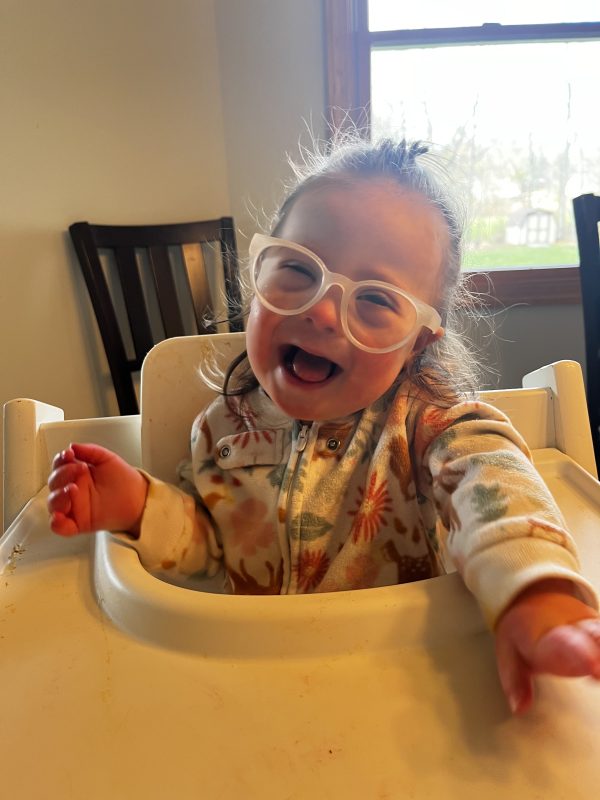
Lenora started taking food by mouth when she about 1 year old.
Finding joy in everyday moments
Today, at 21 months old, Lenora’s world revolves around one person in particular – her big brother.
“She loves him,” Lindsey said. “She loves to play peekaboo.”
While she isn’t standing independently yet, she’s constantly on the move in her own way – rolling, laughing and engaging with the people around her. With the help of a stander and orthotics, she’s working toward her next milestones.
“Her progress may look different, but her joy is unmistakable,” said Lindsey.
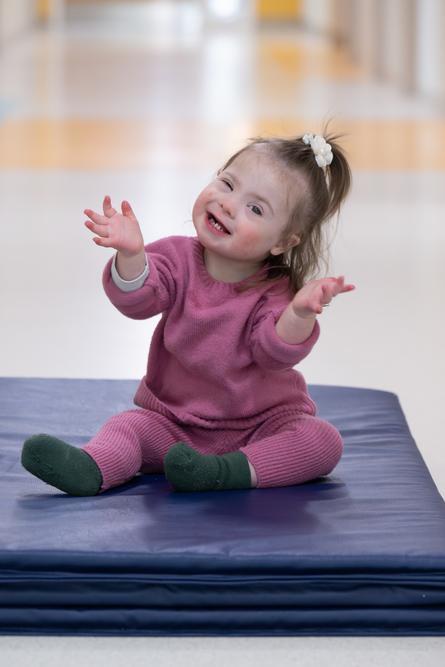
Lenora isn’t standing independently yet, but she’s constantly on the move in her own way. With the help of a stander and orthotics, she’s working toward her next milestones.
What families want others to understand about Down syndrome
Through Lenora’s journey, Lindsey says her perspective has completely changed.
“I want people to understand the amount of work it takes people with Down syndrome to do simple things like swallowing,” she said. “Instead of feeling bad for them, acknowledge their resiliency.”
She hopes others see children like Lenora not as victims, but as strong individuals.
“She’s an incredible human who has overcome unimaginable pain with a smile on her face,” said Lindsey.
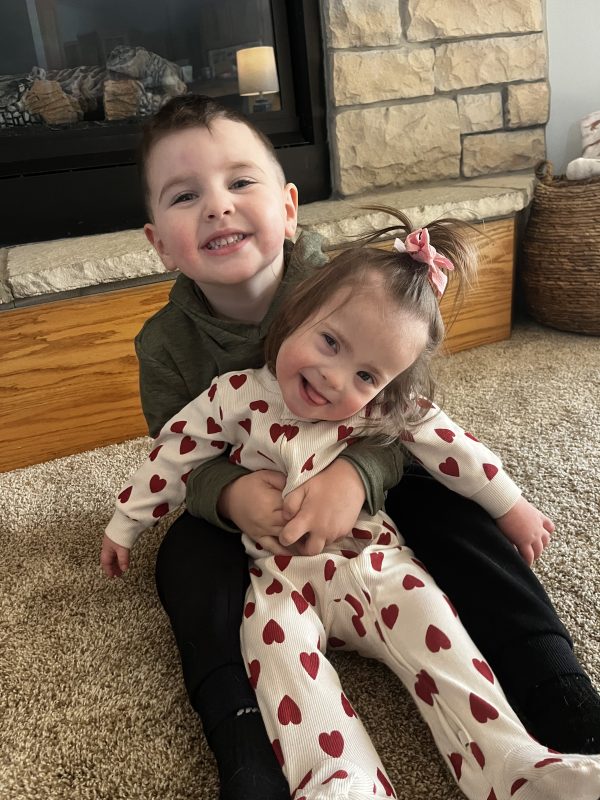
Lenora and her favorite person (and big brother) Calvin.
The power of support
Lindsey credits much of her own strength to the people around her – both inside and outside the hospital.
“Lenora’s great uncle, Patrick, who was a nurse at Akron Children’s for 40 years, visited her almost every day in the NICU and during her ER visits,” said Lindsey. “My mother (Leann), mother-in-law (Patty) and sister-in-law (Mallory), who are all nurses, helped us navigate medical complexities and have been Lenora’s guardian angels since she was born.”
Lindsey also credits Lenora’s primary NICU nurse Lea Drake and a community of other moms raising children with Down syndrome who became unexpected lifelines.
“It’s a group I didn’t know I needed,” she said. “It just organically fell into my lap.”
One of those connections began in the NICU, where Lindsey met Kat Finley, a physical therapist at Akron Children’s, whose daughter also has Down syndrome. That friendship – and others like it – helped her feel less alone.
She’s equally grateful for Lenora’s medical team.
“Lenora wouldn’t be here without them,” Lindsey said.
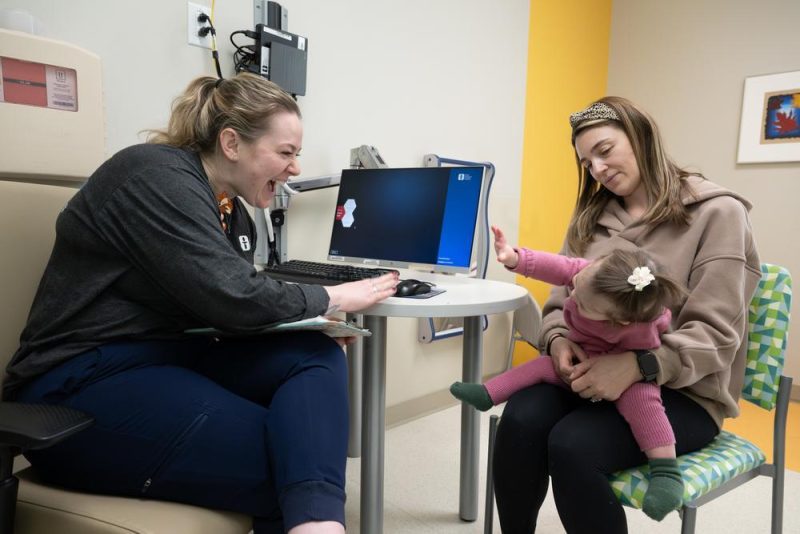
Lenora visits with Julia Thomas, sleep language pathologist, in the Akron Children’s Down syndrome clinic.
A life forever changed
Raising Lenora has transformed Lindsey in ways she never anticipated.
“She has made me more patient, more compassionate, more empathetic and less judgmental,” she said. “I’ve learned that people are doing the best they can on their own journeys.”
Lenora has changed how her family sees the world – and how they hope others will see children like her. Not as limitations or labels, but as individuals defined by strength, resilience and joy. And every day, Lenora continues to show exactly what that looks like.
Similar stories:
How one family found fast relief for their baby’s chronic ear infections
Dr. Ananth Murthy, patient Elijah Bell talk advancements in ear reconstruction
Overweight Kids Take a Lot of Grief. Here’s How to Help.
Gallstones in Kids a Growing Concern
An emergency visit for stitches inspires the story of ‘Stitch’em Up Doug and the Wild Child’
Learn more about Maternal-Fetal Medicine and the Down syndrome program.