Home > Inside Blog > Tips & Advice > Seize the golden opportunity that summer presents and delve into a good book
Seize the golden opportunity that summer presents and delve into a good book
Marketing and Communications Staff Writer
Reading is essential because it improves a child’s comprehension and language skills.
Summer is a time to enjoy fun in the sun and take a break, but many parents wonder if their child will regress when it comes to what they learned the past school year.
While tutors, camps and school-based summer enrichment programs may be part of your child’s plans, don’t overlook the evergreen answer to “summer slide” concerns: open a book.
“Reading to children not only improves a child’s vocabulary, skills like recognition of sounds and letters, and a child’s listening skills, it also promotes healthy, nurturing relationships with loved ones,” said Dr. Jessica Foster, director of Developmental Behavioral Pediatrics at Akron Children’s. “When you hold your child close while enjoying a book together, you can both relax, de-stress and enjoy the creativity and fun of the pictures and stories. Children who spend time enjoying books from a very young age are much more likely to grow into young people who are excited to read on their own.”
Ways to include reading in your summer plans
Set aside time every day for reading. Even when your child is reading on his or her own, continue to read aloud at bedtime or another time on a regular basis.
Most public library systems offer summer reading programs that award children with prizes for reading a set number of books. They also offer a variety of programs ranging from arts and crafts to teen book discussion groups.
Listen to books while you take long drives. Your library probably has a good selection of books on CD or may be affiliated with an app and allows you to listen to audiobooks on your smartphone or synced to your car via Bluetooth.
Parents can also encourage their kids to keep a summer journal, write letters to pen pals, play board games and do word searches to increase word comprehension.
Invite friends over for a backyard summer reading club. Pick age-appropriate titles, put dates, times and titles on a flyer, and plan some discussion questions. For extra fun, include activities or a snack related to the theme of the book.
If your child really resists a daily reading time, don’t push hard. It’s better to keep the association with reading “fun” rather than “punishment.”
For little ones, keep the focus on snuggling and relaxing together. As your child gets older, tap into his or her interests. Whether that be “Star Wars,” telling jokes or learning about insects, there are books out there on every topic and written at all reading levels.
Akron Children’s has books readily available for patients of all ages.
Electronic or paper books
Reluctant readers may argue that they are getting their reading quota of the day done on social media and by web browsing. But Dr. Foster says there is still something very special about the printed page in cognitive development.
“There are benefits to reading in electronic and in paper forms, but they are different ways of reading,” she said. “When kids read online, it is much easier to be distracted – such as by a message that pops up from a friend. Therefore, kids may be less likely to read carefully to really comprehend what they are reading.
“We also tend to read really quickly in a digital format. In addition to being distracted, it is very easy to skip over important information. It is fine to scan digital media to capture main ideas. But to really understand a subject, and especially to remember the details, reading books or articles in print is better.”
The pros and cons of audiobooks
Some kids may especially love audiobooks, but keep in mind their pros and cons.
“When we read a print book, we are using our brains differently than when we are listening to an audiobook,” Dr. Foster said. “Both listening and reading print can be really effective ways of learning, but they are different ways of learning. Depending on the purpose of the reading and your own child’s strengths and abilities, you might choose one form over another.
“For example, audiobooks are a great way to enjoy a story while multitasking. But if you need to go back in the text to reread or review something you missed or misunderstood, it can be challenging to do,” she explained. “When you use print books, you can underline, highlight and more quickly look back to clarify what you have read.
“Kids also benefit from using multiple senses when reading. For example, the simple act of turning pages gives a sense of where you are in a story,” Dr. Foster explained. “There is some evidence that the physical senses of touch and smell – such as the feel of the paper and smell of the book – can also promote learning.”
Together, Akron Children’s and the J.M. Smucker Company promote childhood literacy.
Leaving the doctor’s office with a book
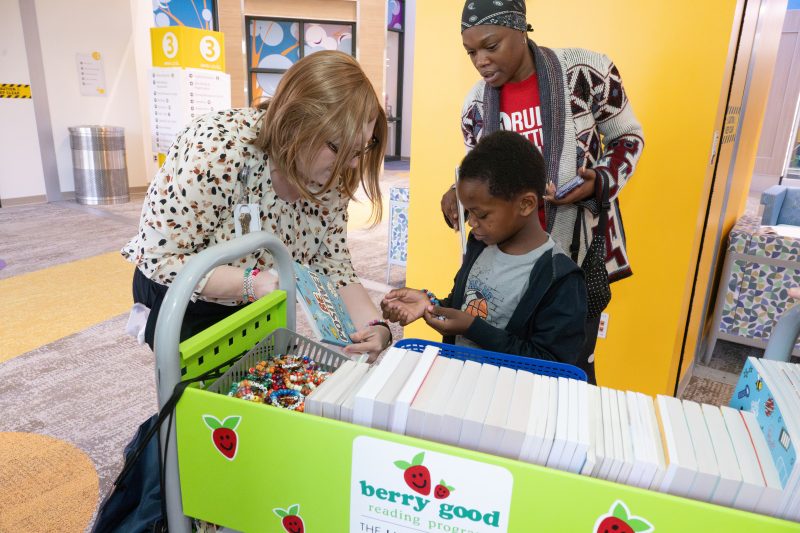
Akron Children’s fully supports childhood literacy through its Berry Good Reading Program. The program recently distributed more than 1,700 books for school-age and teen patients of Akron Children’s Pediatrics – and has made more than 4,000 books available to patients for special events like Read Across America and Mental Health Awareness recognitions.
Doctors offer books to children in need at both the Akron and Boardman emergency rooms. Hospital staff actively work to get children signed up for the Imagination Library, which makes them eligible to receive a new book a month until the age 5.
Inside Children’s is an online community that provides inspirational patient and staff stories as well as information about health and parenting, hospital news, fundraising events and more.